
History
Three drones, four shells: the secret fuze that first beat unmanned aircraft
In August 1942 a U.S. cruiser test was meant to last two days. It ended on the first morning, and the idea behind it is still inside today's counter-drone missiles.
Editorial desk5 min read
On 12 August 1942, gun crews on the cruiser USS Cleveland began a test over Chesapeake Bay. Their targets were radio-controlled drone aircraft; their shells carried a new, secret fuze. The trial was planned for two days. It was stopped early on the first, because there was nothing left to shoot at: three drones had been destroyed with four shells.
A radio in a shell
Until then an anti-aircraft shell had to be set to burst after a fixed time, and the gunners had to guess the range. The proximity fuze — the 'VT' fuze — instead carried a tiny Doppler radio: it transmitted, listened for the echo from a nearby aircraft, and detonated the shell when the echo was strong enough.
The concept came from British researchers at the Telecommunications Research Establishment, who shared it with the United States in 1940 through the Tizard Mission. The hard part was done in America, by Merle Tuve's Section T at the Johns Hopkins Applied Physics Laboratory: making valves and circuits survive being fired from a gun at up to 20,000 g while spinning at close to 30,000 rpm. A January 1942 test showed 52% of fuzes working against a water target, a failure rate the U.S. Navy accepted.
The first flying bombs
Its most famous use was against the first mass-produced unmanned attack aircraft: the German V-1 flying bomb. In 1944 the fuzes went to Britain's Anti-Aircraft Command, whose guns were moved into a thin coastal belt so that duds would fall into the sea rather than into German hands. Combined with the SCR-584 tracking radar and the M9 gun director, the proportion of V-1s destroyed crossing the gun belt rose from 17% to 74% over the campaign, reaching 82% on one day.
“While no one invention won the war, the proximity fuze must be listed among the very small group of developments, such as radar, upon which victory very largely depended.”
Why it still matters
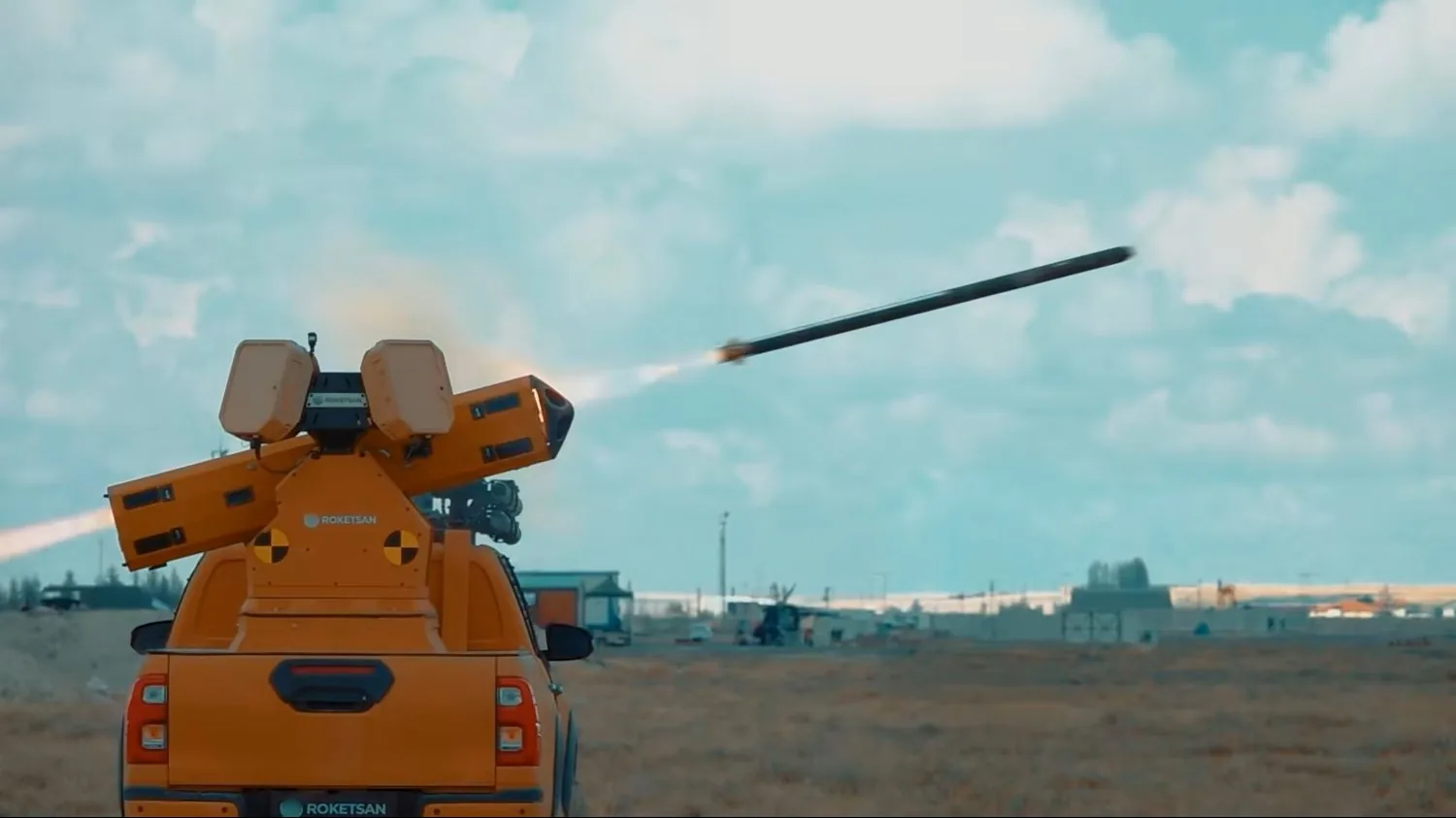
Eighty years later the problem is the same: a small, cheap aircraft is hard to hit directly, so the weapon has to detonate close to it. CİRİT C-UAS adds an RF proximity fuze to a laser-guided rocket; APKWS uses a proximity fuze developed for drone targets; the Stinger's newest version gets one for unmanned aircraft. The radio in the shell has become the radio in the missile.
Originally published by World of Interceptors at www.worldofinterceptors.com/blog/three-drones-four-shells. Quote or republish it freely with a link to this page. Compiled from open sources and cross-checked, but accuracy cannot be guaranteed; manufacturers and independent organisations can ask us to correct or remove information (disclaimer).
Sources
- 1.
Proximity fuze (opens in a new tab)
Wikipedia · Reference work (secondary) · Retrieved
Supports: British origin and U.S. development (Section T, APL); USS Cleveland test of August 1942; V-1 kill rate rising from 17% to 74%; seabird detonations; Battle of the Bulge
- 2.
SAHA EXPO 2026: ROKETSAN's C-UAS specialised CİRİT variant (opens in a new tab)
TURDEF · Specialist press · Published · Retrieved
Supports: RF proximity fuze, revised flight control, PUSU-C with radar and EO/IR, 5 km
- 3.
APKWS laser-guidance kits successfully tested by U.S. counter-drone office (opens in a new tab)
BAE Systems · Manufacturer · Published · Retrieved
Supports: JCO test; 100% effectiveness claimed against 25–50 lb drones
- 4.
Army Recognition · Specialist press · Published · Retrieved
Supports: FIM-92J proximity fuze for unmanned targets; differing published speed and range figures
Newsletter · every two weeks
The Interceptors Brief
What changed in air defence and counter-drone, in five minutes, with the sources attached.
Confirm by email · unsubscribe in one click · Privacy
More from the blog
 War story
Three gunships near Jalalabad: the Stinger's first shots in Afghanistan, and how much they really changed
On 25 September 1986 a small mujahideen team fired the first CIA-supplied Stingers at Soviet Mi-24 helicopters. The moment became legend; the numbers behind it are still argued over.
 Explainer
What a Patriot missile really costs: PAC-3 MSE, GEM-T, a full battery and Iron Dome compared
The U.S. Army's own budget books put a PAC-3 MSE at about $4.2 million for the missile alone and about $5 million with its share of hardware. Here is where that number comes from, what a GEM-T and a whole battery cost, and how Iron Dome compares.
 Explainer
Interceptor drones compared: the cheap hunters built to stop the Shahed
From $1,000 Ukrainian quadcopters to $100,000 jet-powered American rounds: speed, warhead, price and status of every interceptor drone used or offered against Shahed-type drones, with the numbers behind the boom.