
Interceptor Missiles · Medium-range air-defense missiles
Evolved SeaSparrow Missile (ESSM)
Also known as RIM-162; RIM-162 ESSM; Evolved Sea Sparrow; Evolved Seasparrow; ESSM Block 2; ESSM Block II; Sea Sparrow; SeaSparrow; NATO SeaSparrow
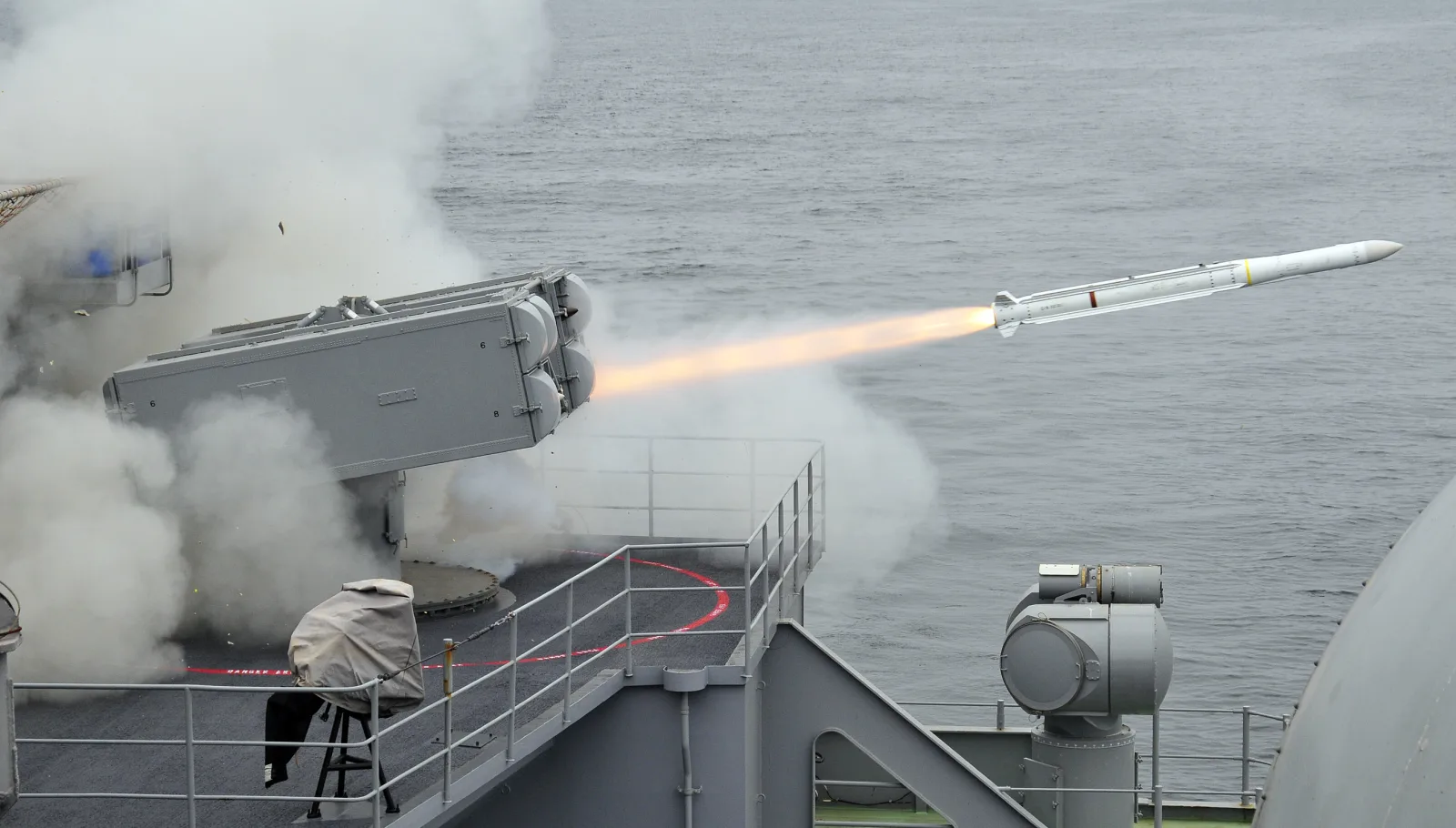
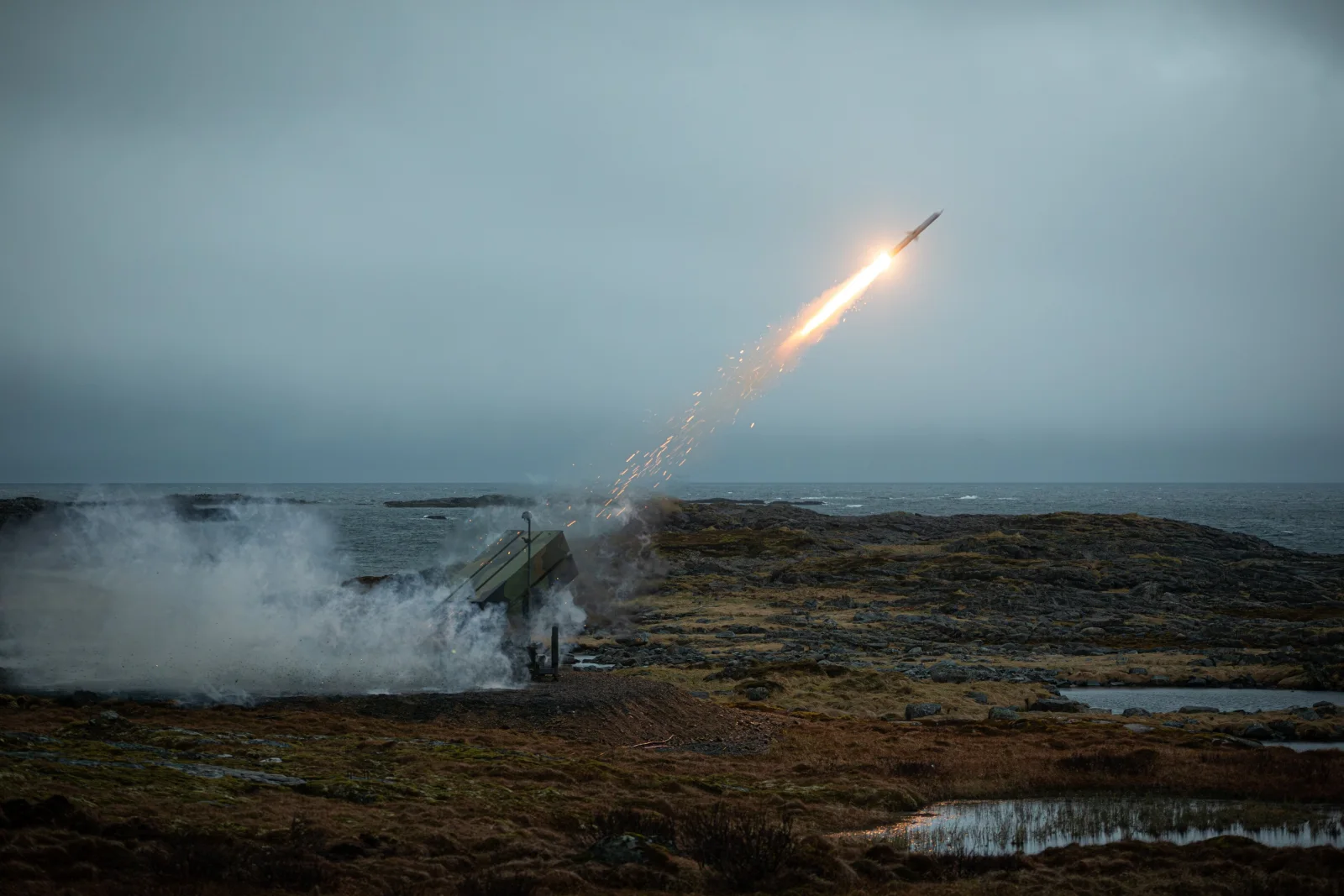
RTX's RIM-162 ship self-defence missile, a faster, more agile successor to the RIM-7 Sea Sparrow: about 50 km range at Mach 4, packed four to a Mk 41 cell, against anti-ship cruise missiles, aircraft and fast surface craft. In U.S. Navy service since 2004; Block 2 adds an active seeker.
- Range
- about 50 km
- Speed
- Mach 4
Sourced record, not yet reviewed. Compiled from the public sources listed below. Every figure is attributed to its source; where sources disagree, both values are shown. No editor has reviewed this record yet.
Overview
The Evolved SeaSparrow Missile (ESSM, RIM-162) is a medium-range surface-to-air missile that protects warships against anti-ship cruise missiles, low-velocity air threats such as helicopters and drones, and fast, manoeuvring surface craft (CSIS; RTX). It descends from the RIM-7 Sea Sparrow, itself a ship-launched version of the AIM-7 Sparrow air-to-air missile. Compared with the original, ESSM added a midcourse data uplink, inertial guidance alongside semi-active radar homing, a redesigned warhead section and tail control by thrust vectoring for high speed and agility (CSIS). It works alongside SM-2 and SM-6 as the inner layer of a ship's air defence.
ESSM is an international programme. After the Israeli destroyer Eilat was sunk by an anti-ship missile in 1967, Denmark, Italy, Norway and the United States formed the NATO Seasparrow Consortium in 1968; it now has 12 members, and ten of them (Australia, Canada, Denmark, Germany, Greece, the Netherlands, Norway, Spain, Türkiye and the United States) take part in ESSM (CSIS). RTX describes Block 1 as a 10-nation cooperative development and a kinematic upgrade of the RIM-7P. Japan, Thailand, the UAE and others have bought it as non-members.
CSIS gives a length of 3.64 m, a diameter of 0.254 m, a range of about 50 km and a speed of Mach 4 on a solid-propellant motor. The missile can home all the way on reflected radar energy or fly an inertial midcourse with updates from the ship, and on Aegis ships it takes uplinked commands from the SPY-1 radar. It fits the Mk 29 trainable launcher, the Mk 41, Mk 48 and Mk 57 vertical launchers and the Mk 56 dual pack; in a Mk 41 cell four missiles are quad-packed, so a destroyer can carry many more ESSMs than larger missiles.
Block I testing began in March 2000; in July 2002 USS Shoup made the first launch from a Mk 41 cell on an Arleigh Burke-class destroyer, and the U.S. Navy has operated ESSM since 2004 (CSIS). RTX reports more than 330 live firings at sea. The first combat use came on 9 October 2016, when USS Mason fired SM-2s, an ESSM and a Nulka decoy against two anti-ship missiles launched from Yemen; which weapon defeated the second missile is unclear. Block 2 adds an active seeker, so it depends less on the ship's illuminator radars, and a new blast-fragmentation warhead; its first guided flight test was on 12 June 2018 (RTX), and seven nations are buying it (CSIS).
Technical profile
Seeker, guidance, warhead, data link and launcher as described in public sources. Each line cites its source.
| Seeker | Semi-active radar (Block 1); active radar added in Block 2 | Secondary reference[1] |
|---|---|---|
| Guidance | Home-all-the-way semi-active homing, or inertial midcourse with ship updates and X-band or S-band terminal guidance; uplink from the Aegis SPY-1 radar | Secondary reference[1] |
| Warhead | Redesigned warhead section; new blast-fragmentation warhead in Block 2 | Secondary reference[1] |
| Motor / propulsion | Solid rocket motor with laser ignition; thrust-vector tail control | Secondary reference[1] |
| Launcher | Mk 29 trainable launcher; Mk 41 (four per cell), Mk 48 and Mk 57 vertical launchers; Mk 56 dual pack | Secondary reference[1] |
Publicly documented characteristics
Each figure shows where it comes from. “Not publicly disclosed” means no source we hold gives a figure; it is never treated as zero.
| Characteristic | Value | Evidence and sources |
|---|---|---|
| Maximum range (km) | ≈ 50 kmBasis: Range reported in secondary sources | Secondary reference[1] |
| Speed (m/s) | Mach 4 | Secondary reference[1] |
| Length (m) | 3.64 m | Secondary reference[1] |
| Diameter (mm) | 254 mm | Secondary reference[1] |
| Guidance / cueing | Inertial with midcourse uplink and semi-active radar homing (Block 1); active and semi-active seeker (Block 2) | Secondary reference[1] |
| Ready rounds / magazine | 4 per Mk 41 cell (quad-pack) | Secondary reference[1] |
| Launch / operating platform | Warships: Mk 29, Mk 41, Mk 48, Mk 56 and Mk 57 launchers | Secondary reference[1] |
Platforms and integration
Launchers, vehicles, ships, aircraft, sensors and command systems the record is integrated with, by status.
| Platform or system | Domain | Status | Sources |
|---|---|---|---|
| Aegis destroyers and cruisers (Mk 41 VLS) | Naval | In service | [1] |
| Aircraft carriers and amphibious assault ships (Mk 29) | Naval | In service | [1] |
| Allied frigates and corvettes (Mk 41, Mk 48, Mk 56) | Naval | In service | [1] |
Operators
In service (13)
Contracts and orders
Publicly announced contracts, newest first. Values and quantities are as reported; currencies are not converted.
| Date | Customer · contract | Quantity | Value | Sources |
|---|---|---|---|---|
| Naval Sea Systems Command (U.S. Navy, 11 partner governments and Japan) · RaytheonCost-plus-fixed-fee modification to N00024-26-C-5434 for technical and design agent engineering for the ESSM and NATO SeaSparrow programmes; U.S. Navy 36%, Australia, Belgium, Canada, Denmark, Germany, Greece, the Netherlands, Norway, Portugal, Spain and Türkiye 63%, Japan (FMS) 1%; completion December 2030. | — | US$18,977,361 | [3] |
Development and tests
2018-06-12 · Test
First Block 2 guided flight
The U.S. Navy completed the first guided flight test of ESSM Block 2 (manufacturer). [2]
2016-10-09 · Reported combat use
First combat use
USS Mason fired two SM-2s, one ESSM and a Nulka decoy against two anti-ship missiles launched from Yemen; which weapon defeated the second missile is unclear. [1]
2004 · First delivery
U.S. Navy service
The U.S. Navy officially began operating ESSM. [1]
2002-07 · Test
First Mk 41 launch from a destroyer
USS Shoup fired ESSM from a Mk 41 cell with Aegis Baseline 6 Phase III. [1]
2000-03 · Test
Block I testing begins
ESSM destroyed a manoeuvring drone target in its first test round. [1]
1991-04 · Development
Upgrade proposed
The NATO Seasparrow Project Office proposed upgrading the system against faster, more agile low-altitude threats, leading to ESSM. [1]
Capabilities and limitations
Stated capabilities
- About 50 km range and Mach 4 speed (specialist press).
- Four missiles per Mk 41 cell (quad-pack); also fired from Mk 29, Mk 48, Mk 56 and Mk 57 launchers (specialist press).
- Against anti-ship cruise missiles, helicopters and drones, and fast manoeuvring surface craft (manufacturer; specialist press).
- More than 330 live firings at sea (manufacturer).
Limitations and open questions
- Block 1 relies on semi-active radar homing, so ships must illuminate the target until impact; Block 2's active seeker is meant to ease this (specialist press).
- Block 1 is not insensitive-munitions compliant under NATO standards (specialist press).
- Block 2 operational testing in 2021 found deficiencies to fix before the final evaluation (specialist press).
Relevance to threats
Listed by the strength of the evidence. Inclusion here is not a claim of proven effectiveness.
- Cruise missilesSecondary reference
Anti-ship cruise missiles are ESSM's primary design threat (specialist press; manufacturer); combat effect in the 2016 USS Mason engagement is unconfirmed.
Frequently asked questions
Short answers drawn from the sources below. Where sources disagree, the answer gives the range.
What is the range of the ESSM?
About 50 km, according to CSIS, at a speed of Mach 4. RTX does not publish a range figure. [1][2]
What is the difference between ESSM Block 1 and Block 2?
Block 1 homes on radar energy reflected from the target, so the ship must keep illuminating it. Block 2 adds an active seeker, which reduces that dependence, and a new blast-fragmentation warhead. Its first guided flight test was on 12 June 2018. [1][2]
How many ESSMs fit in a Mk 41 cell?
Four. ESSMs are quad-packed in a single Mk 41 vertical launch cell on Aegis ships; the missile can also be fired from Mk 29, Mk 48, Mk 56 and Mk 57 launchers. [1]
Which countries use the ESSM?
CSIS lists Australia, Canada, Denmark, Germany, Greece, Japan, the Netherlands, Norway, Spain, Thailand, Türkiye, the UAE and the United States, among others. Ten NATO Seasparrow Consortium members take part in the programme, and a July 2026 U.S. contract also funded Belgium and Portugal. [1][3]
Has ESSM been used in combat?
Yes. On 9 October 2016 USS Mason fired one ESSM, two SM-2s and a Nulka decoy against two anti-ship missiles launched from Yemen. One missile fell into the sea; CSIS says it is unclear which weapon defeated the other. [1]
Sources
- 1.
Evolved Seasparrow Missile (ESSM) (opens in a new tab)
CSIS Missile Threat · Specialist press · Retrieved
Supports: RIM-162 derived from the RIM-7 Sea Sparrow; 3.64 m long, 0.254 m diameter, about 50 km range, Mach 4, inertial and semi-active radar guidance, solid propellant; U.S. Navy service since 2004; NATO Seasparrow Consortium (1968, 12 members), ten in the ESSM programme; Block I tests from March 2000, first Mk 41 launch from USS Shoup July 2002; guidance modes; Mk 29, Mk 41 (quad-packed), Mk 48, Mk 56 and Mk 57 launchers; operators and ships; Block 2 active guidance and new blast-fragmentation warhead; first combat use from USS Mason, 9 October 2016
- 2.
ESSM Missile (opens in a new tab)
RTX (Raytheon) · Manufacturer · Retrieved
Supports: Ship self-defence against anti-ship cruise missiles, low-velocity air threats such as helicopters and high-speed manoeuvrable surface threats; Block 1 is a 10-nation cooperative programme and a kinematic upgrade of the RIM-7P; more than 330 live firings at sea; first guided flight test of Block 2 on 12 June 2018
- 3.
Contracts for July 22, 2026 (opens in a new tab)
U.S. Department of War · Government · Published · Retrieved
Supports: Raytheon $18,977,361 cost-plus-fixed-fee modification to N00024-26-C-5434 for technical and design agent engineering for the ESSM and NATO SeaSparrow programmes; U.S. Navy 36%, eleven partner governments under memoranda of agreement 63%, Japan (FMS) 1%; completion December 2030; NAVSEA contracting activity
This record is compiled and kept up to date by World of Interceptors at www.worldofinterceptors.com/systems/essm. Cite it with a link to this page. Compiled from open sources and cross-checked, but accuracy cannot be guaranteed; manufacturers and independent organisations can ask us to correct or remove information (disclaimer).
Related systems
Revision history
· Created
Record created from CSIS Missile Threat, RTX and a War Department contract announcement; added a U.S. Navy launch photo.
Newsletter · every two weeks
The Interceptors Brief
What changed in air defence and counter-drone, in five minutes, with the sources attached.
Confirm by email · unsubscribe in one click · Privacy