
Platform
IAI Harpy
Israeli anti-radiation loitering munition, first tested in 1989, that hunts radar emitters autonomously; sold to several countries including China.
- Speed
- up to 185 km/h
- Range
- 200 km
- Warhead
- 32 kg
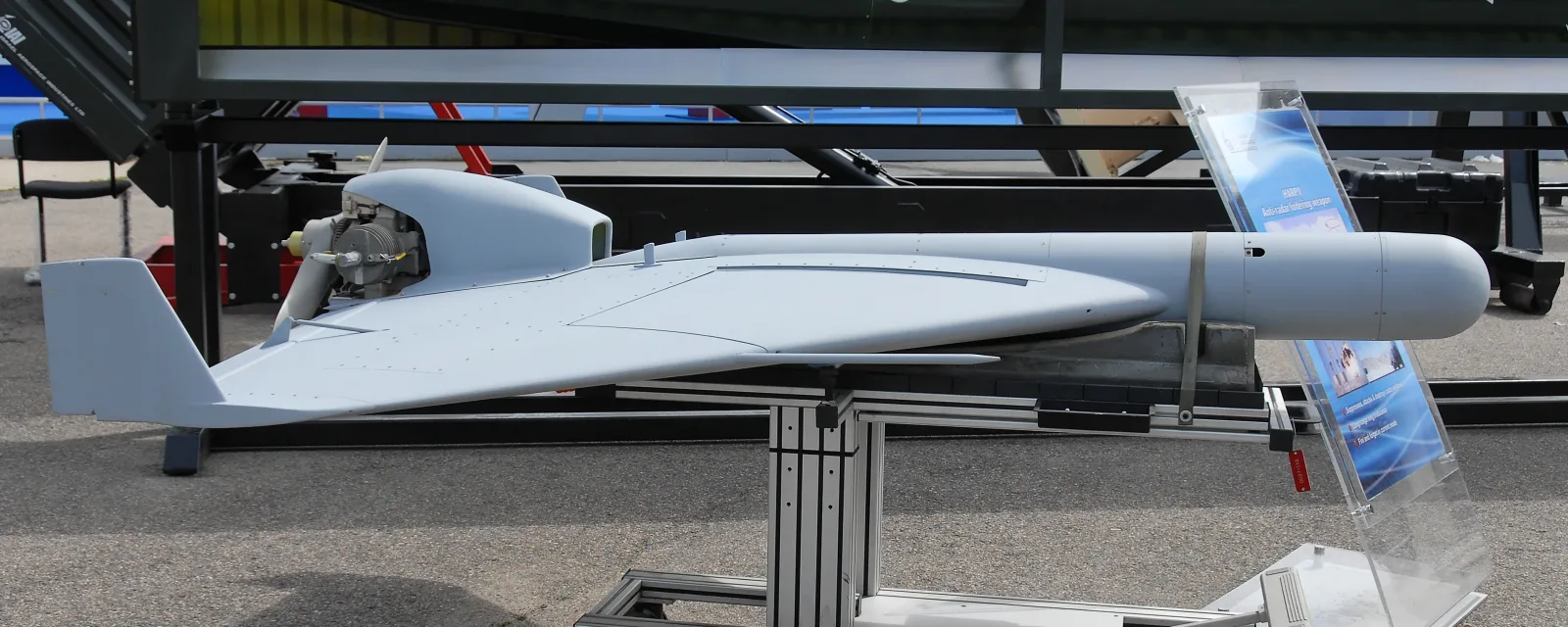
Sourced record, not yet reviewed. Compiled from the public sources listed below. Every figure is attributed to its source; where sources disagree, both values are shown. No editor has reviewed this record yet.
Overview
Harpy was developed by IAI from South African Kentron ARD-10 designs and first tested in 1989. It is launched from canisters, loiters over an area and dives on radar emitters picked up by its anti-radiation seeker. Reference figures: 2.7 m long, 2.1 m span, 135 kg, Wankel engine, 185 km/h, 200 km range and a 32 kg warhead (reference work).
IAI describes missions of up to 9 hours, including in GNSS-denied areas. Harpy NG extends seeker coverage from 2–18 GHz to 0.8–18 GHz. Harpy was sold to South Korea, India and China; a planned upgrade of China's Harpys caused a U.S.–Israeli dispute in 2004–2005, and China's later Feilong-300A was modelled on it (manufacturer; reference work).
Family, aliases and variants
Each designation keeps its own record. Links show the type of relationship and how well it is supported.
- Harpy NG
- Next-generation version with longer endurance and wider seeker band
Related records
Each card is a separate record. Copies built outside the original country, and comparable designs that are not copies, are labelled on their own pages.
Primary classification
Aerial Threats › Loitering munitions › Longer-range
Longer-range loitering munition with autonomous anti-radiation homing.
Characteristics
- Autonomous navigation
- Weaponized
Publicly documented characteristics
Figures for this record circulate in public reporting but are withheld until a source is attached and checked.
| Characteristic | Value | Evidence and sources |
|---|---|---|
| Length (m) | 2.7 m | Secondary reference[1] |
| Wingspan (m) | 2.1 m | Secondary reference[1] |
| Mass (kg) | 135 kg | Secondary reference[1] |
| Speed (m/s) | Up to 51 m/s185 km/h. | Secondary reference[1] |
| Maximum range (km) | 200 kmBasis: Range reported in secondary sources | Secondary reference[1] |
| Payload / warhead (kg) | 32 kg | Secondary reference[1] |
| Endurance (min) | Up to 540 min9 hours for current versions. | Manufacturer claim[2][3] |
| Guidance / cueing | Anti-radiation seeker; autonomous fire-and-forget | Manufacturer claim[2] |
Relevant interception technology classes
Technology classes discussed in connection with this threat. This is not a statement that any class is proven effective against it.
- Interceptor Missiles—
- Guns & Interceptor Ammunition—
- Detection, Tracking & CommandRadar emission control is a classic defence against anti-radiation weapons.
Known uncertainties
- Combat use of the Harpy itself is less documented than that of the Harop.
Sources
- 1.
IAI Harpy (opens in a new tab)
Wikipedia · Reference work (secondary) · Retrieved
Supports: Harpy anti-radar loitering munition, first tested 1989 from Kentron ARD-10 designs; 2.7 m length, 2.1 m span, 135 kg, Wankel engine, 185 km/h, 200 km range, 32 kg warhead; sold to South Korea, India and China; 2004–2005 U.S.–Israel dispute over Chinese upgrade.
- 2.
HARPY – Anti Radiation Loitering Munition (opens in a new tab)
Israel Aerospace Industries · Manufacturer · Retrieved
Supports: Harpy SEAD/DEAD role, launch from ground or naval canisters without prior target location, anti-radiation seeker, missions up to 9 hours, operation in GNSS-denied environments.
- 3.
IAI Harpy NG (opens in a new tab)
Wikipedia · Reference work (secondary) · Retrieved
Supports: Harpy NG as a fire-and-forget anti-radiation loitering weapon with 9 hours airborne time and seeker coverage widened from 2–18 to 0.8–18 GHz.
This record is compiled and kept up to date by World of Interceptors at www.worldofinterceptors.com/threats/iai-harpy. Cite it with a link to this page. Compiled from open sources and cross-checked, but accuracy cannot be guaranteed; manufacturers and independent organisations can ask us to correct or remove information (disclaimer).
Newsletter · every two weeks
The Interceptors Brief
What changed in air defence and counter-drone, in five minutes, with the sources attached.
Confirm by email · unsubscribe in one click · Privacy