
Interceptor Drones · Explosive or fragmentation-effect interceptors
TYTAN interceptors (METIS and EOS)
Also known as TYTAN TI-1 METIS; TYTAN TI-2 EOS; Tytan interceptor
German start-up TYTAN Technologies' family of AI-guided interceptors, selected for a Bundeswehr programme and used in Ukraine.
- Range
- 20–60 km
- Speed
- 200–375 km/h
Sourced record, not yet reviewed. Compiled from the public sources listed below. Every figure is attributed to its source; where sources disagree, both values are shown. No editor has reviewed this record yet.
Overview
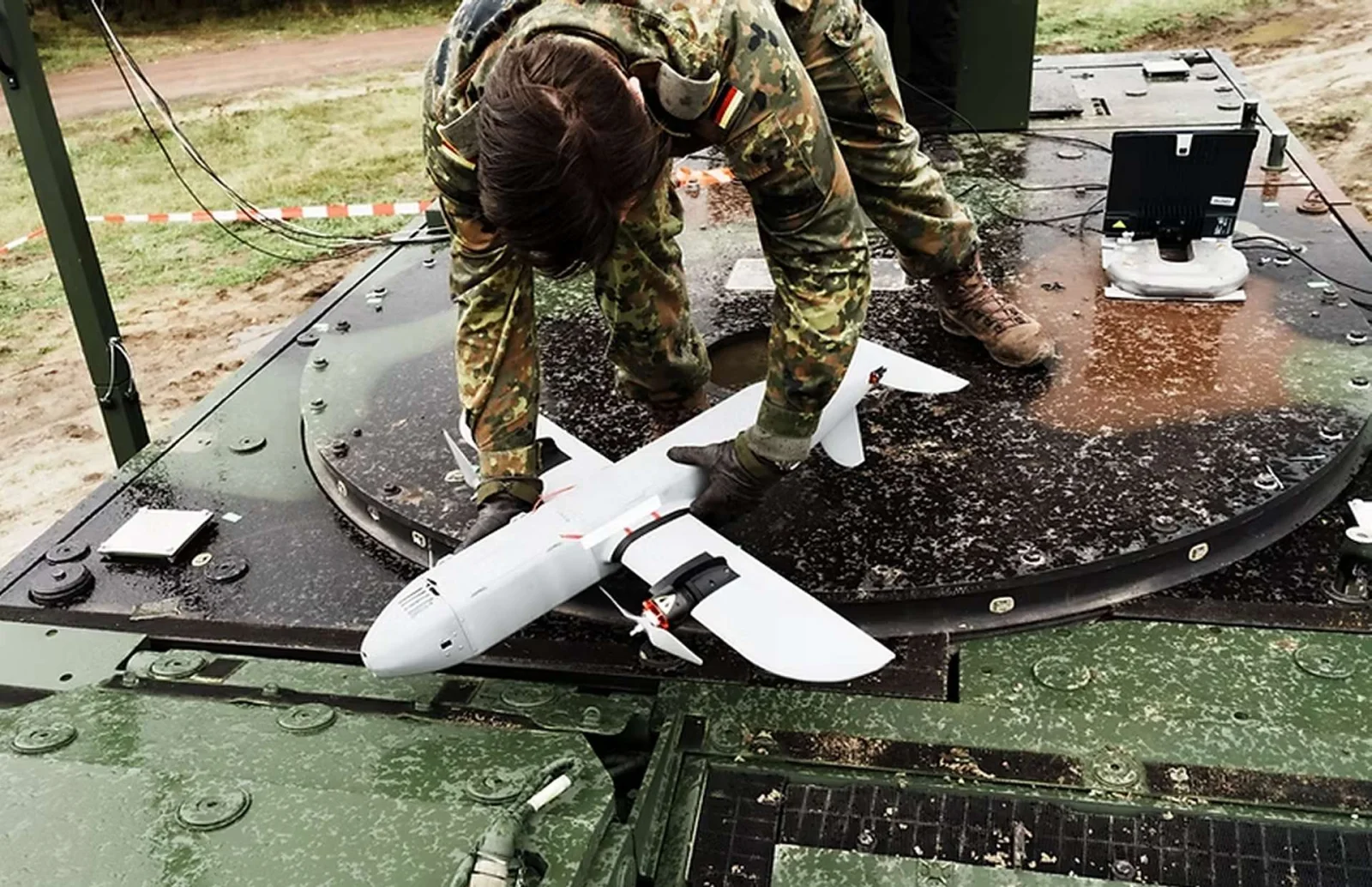
TYTAN Technologies of Munich builds autonomous interceptors that are cued by ground radar and finish the attack with an AI-powered thermal camera. A single operator can control several interceptors.
The company lists two models: TI-1 METIS, a long-range interceptor for NATO Class II drones with a fragmentation warhead, and TI-2 EOS, a cheaper high-speed kinetic interceptor. Defense News describes EOS as a short-range multicopter and METIS as a long-range fixed-wing design.
Germany selected TYTAN in October 2025 for a multi-hundred-million-euro interceptor programme (specialist press citing Bloomberg). Defense News reports the interceptors are extensively used in Ukraine and that a new factory is sized for 3,000 a month.
Technical profile
Seeker, guidance, warhead, data link and launcher as described in public sources. Each line cites its source.
| Seeker | AI-powered thermal camera | Manufacturer claim[1] |
|---|---|---|
| Guidance | Ground-radar cueing and autonomous navigation; computer-vision terminal guidance, reported to work under GPS denial | Manufacturer claim[1][2] |
| Warhead | METIS: collision or fragmentation warhead (about 1.2 kg payload); EOS: no explosive, collision onlyArmy Recognition reports a proximity-fuzed fragmentation option for the Bundeswehr system. | Manufacturer claim[1][4] |
| Motor / propulsion | METIS: fixed wing with two electric motors; EOS: multicopter | Secondary reference[3][4] |
| Data link | Data link for human override at launch and in the terminal phase | Secondary reference[2] |
| Launcher | Tripod stand; vehicle-mounted rails or ISO container holding several ready rounds | Secondary reference[1][2] |
| Fire control / radar | Plugs into existing sensors and C2; one operator controls several interceptors | Manufacturer claim[1] |
Publicly documented characteristics
Each figure shows where it comes from. “Not publicly disclosed” means no source we hold gives a figure; it is never treated as zero.
| Characteristic | Value | Evidence and sources |
|---|---|---|
| Speed (m/s) | 56–104 m/s200 km/h (EOS) to 375 km/h (METIS). | Manufacturer claim[1] |
| Maximum range (km) | 20–60 kmBasis: Maximum engagement range as claimed by the developer20 km (EOS) to 60 km (METIS). | Manufacturer claim[1] |
| Maximum altitude (km) | 3–5 km | Manufacturer claim[1] |
| Mass (kg) | 3.5–6 kg | Manufacturer claim[1] |
| Payload / warhead (kg) | 1.2 kgMETIS; EOS carries no payload. | Manufacturer claim[1] |
| Guidance / cueing | Ground radar and autonomous navigation; AI thermal camera | Manufacturer claim[1] |
Platforms and integration
Launchers, vehicles, ships, aircraft, sensors and command systems the record is integrated with, by status.
| Platform or system | Domain | Status | Sources |
|---|---|---|---|
| Boxer with RCT30 turret (interceptor in a vehicle compartment) · GermanyDemonstrated in a 2025 Bundeswehr trial. | Land | Tested | [4] |
| Mercedes-Benz G-Class and Sprinter vehicle platformsMemorandum of understanding signed at ILA 2026. | Land | Proposed | [1][4] |
| Hensoldt sensors and C2Cooperation agreement signed January 2026. | Sensor / C2 | In development | [4] |
Operators
In service (2)
Production and deliveries
Reported production, delivery and order figures by period. Gaps mean no public figure, not zero.
Development and tests
2026-08 · Production
New factory scheduled to start
Production at a German factory sized for 3,000 interceptors a month was scheduled to begin in August 2026; Poland and Hungary named as possible further sites. [3][4]
2026-02 · Development
€30 million funding round
Round led by Armira and the NATO Innovation Fund, bringing total funding to €46 million. [4]
2025-10 · Production
Bundeswehr selection
Germany selected TYTAN for a multi-hundred-million-euro interceptor programme, according to Bloomberg as cited by Army Recognition. [2]
2025-01 · Reported combat use
First use in Ukraine
According to TYTAN, its first interceptor was in use in Ukraine against Shahed-136 (Geran-2) drones; no audited interception rate is public. [4]
2025 · Test
Boxer integration trial
A TYTAN interceptor installed in a Boxer with an RCT30 turret was demonstrated in a Bundeswehr trial. [4]
Capabilities and limitations
Stated capabilities
- METIS: 375 km/h, 60 km range, 5,000 m ceiling, 1.2 kg payload (manufacturer).
- EOS: 200 km/h, 20 km range, 3,000 m ceiling, kinetic defeat (manufacturer).
- Designed to plug into existing sensors and command systems (manufacturer).
Limitations and open questions
- Which model the Bundeswehr ordered, and with which payload, has not been published.
- Ukrainian use is reported, but no engagement figures are public.
Relevance to threats
Listed by the strength of the evidence. Inclusion here is not a claim of proven effectiveness.
- One-way attack UAVsManufacturer claim
METIS is aimed at NATO Class II drones.
- Shahed-136 / Geran familySecondary reference
Reported use in Ukraine, where Shahed-type drones are the main long-range threat; no per-target data.
Sources
- 1.
TYTAN Technologies — interceptors (opens in a new tab)
TYTAN Technologies · Manufacturer · Retrieved
Supports: TI-1 METIS: 375 km/h, 60 km, 5,000 m, 6 kg, 1.2 kg payload, fragmentation warhead; TI-2 EOS: 200 km/h, 20 km, 3,000 m, 3.5 kg, kinetic; ground-radar cueing and AI thermal camera
- 2.
Army Recognition · Specialist press · Published · Retrieved
Supports: Multi-hundred-million-euro German programme (citing Bloomberg); kinetic or fragmentation payload; early field use in Ukraine
- 3.
Defense News · Specialist press · Published · Retrieved
Supports: EOS short-range multicopter and METIS long-range fixed-wing; customers Germany and the Baltic states; extensive use in Ukraine; 3,000 a month capacity
- 4.
German firm Tytan aims to industrialise Europe's war on drones (opens in a new tab)
Fly a Jet Fighter · Specialist press · Published · Retrieved
Supports: 3,000 a month factory from August 2026; Ukraine contracts for thousands of METIS (citing NATO Innovation Fund); BAAINBw project; Boxer RCT30 trial 2025; first use in Ukraine January 2025; €30 million round February 2026; METIS two electric motors
This record is compiled and kept up to date by World of Interceptors at www.worldofinterceptors.com/systems/tytan-interceptors. Cite it with a link to this page. Compiled from open sources and cross-checked, but accuracy cannot be guaranteed; manufacturers and independent organisations can ask us to correct or remove information (disclaimer).
Related systems
 © Origin Robotics
 © Skydagger
Revision history
· Created
Record compiled from public sources found through treg web search.
· Update
Added profile, integrations, operators, the Bundeswehr selection, planned production rate and milestones from public sources.
Newsletter · every two weeks
The Interceptors Brief
What changed in air defence and counter-drone, in five minutes, with the sources attached.
Confirm by email · unsubscribe in one click · Privacy