Interceptor Missiles · Long-range air-defense missiles
S-500 Prometey
Also known as S-500 Prometheus; Prometey; Prometheus; S-500; 55R6M Triumfator-M; Triumfator-M; S-500 Prometei
Almaz-Antey's newest Russian long-range air and missile defence system: its 77N6 interceptors are reported to reach 500–600 km and its 40N6M about 400 km, against aircraft, cruise and ballistic missiles and low-orbit satellites. Russia said its first S-500 regiment entered combat duty in December 2025.
- Range
- 500–600 km
Sourced record, not yet reviewed. Compiled from the public sources listed below. Every figure is attributed to its source; where sources disagree, both values are shown. No editor has reviewed this record yet.
Overview
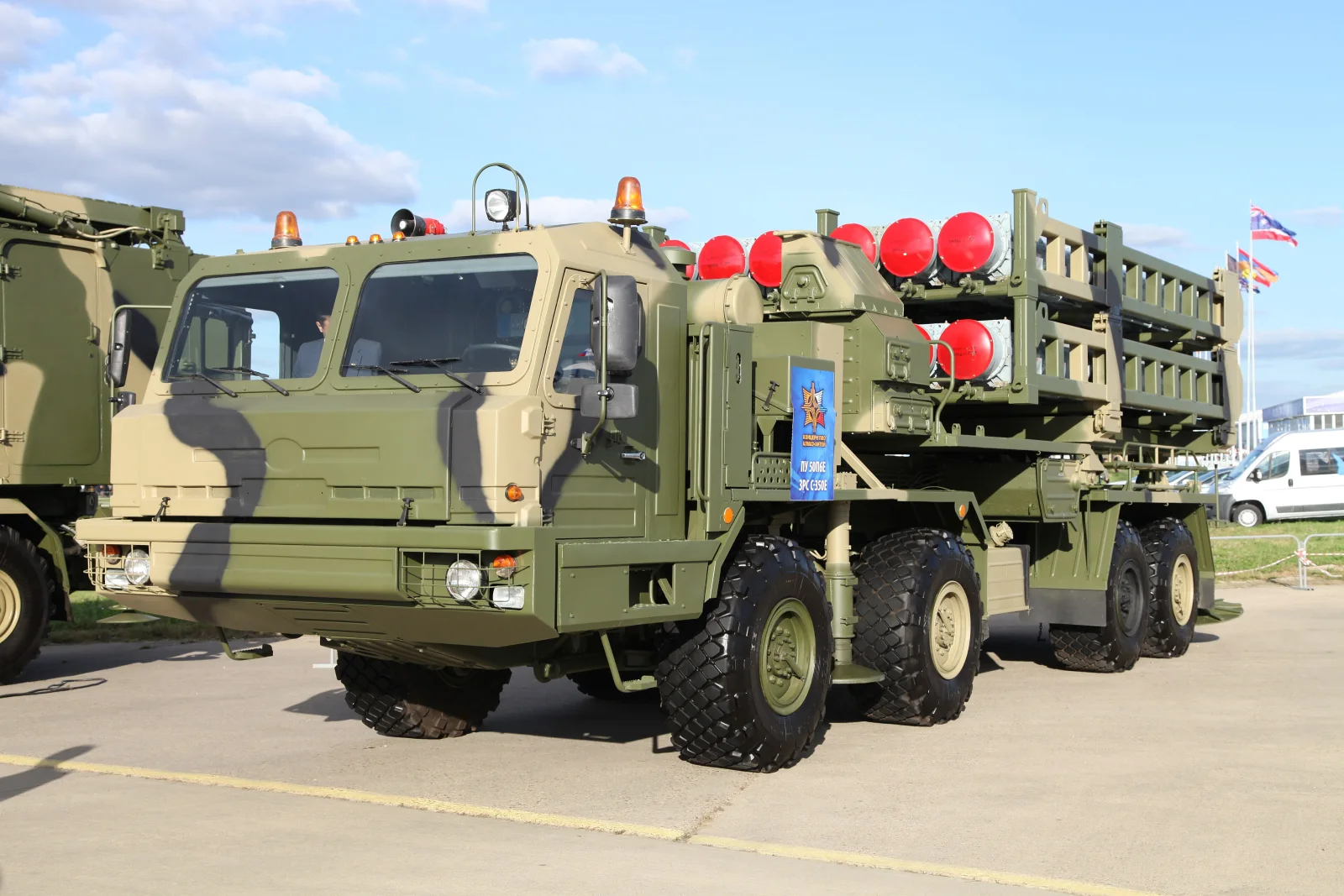
The S-500 Prometey, often written Prometheus in English, is a mobile, ground-based surface-to-air missile system developed by Almaz-Antey. CSIS describes it as designed against aircraft, ballistic missiles and cruise missiles, and reports that it can also engage satellites in low orbit. Russia began work on it in 2010, shortly after the first S-400s were deployed in 2007. It is meant to sit above the S-400 rather than replace it: Russian state media, as quoted by The Defense Post, describe it as filling the gap between tactical air defence and strategic missile defence.
The system fires more than one interceptor. CSIS lists the 40N6M against aircraft and cruise missiles, with a range of about 400 km, and the newer 77N6 and 77N6-N1 against ballistic missiles or satellites, reported to reach 500–600 km. A launcher carries either four 40N6M missiles or two 77N6 interceptors in canisters (The Defense Post). Each battery has four radar vehicles: the 91N6E(M) S-band and 96L6-TsP C-band acquisition radars, the 76T6 multi-mode engagement radar and the 77T6 anti-ballistic-missile engagement radar. CSIS reports that together they can detect ballistic targets at up to 2,000 km and air-breathing targets at up to 800 km.
The programme ran years late. Russia declared the design complete in 2011, but the start of serial production slipped from 2014 to 2017, then to 2021 and 2025; CSIS suggests the delay may have been partly deliberate, to keep S-400 lines free for exports. In May 2018 Russia reportedly hit a target nearly 482 km away with the S-500, described at the time as the longest surface-to-air missile test. Crew training was reported under way in April 2021, and Russia was reported to plan ten battalions.
In January 2025 the Chief of the General Staff, Valery Gerasimov, announced that the first S-500 regiment had been formed. In December 2025 Defence Minister Andrei Belousov said that regiment had entered combat duty as part of the Aerospace Forces' first air and missile defence division; no technical details were released. Russian and Ukrainian media had earlier reported S-500s protecting the Kerch Bridge to Crimea. Russian media claims from 2021 that the system would receive interceptors able to engage hypersonic weapons remain unconfirmed (CSIS).
Technical profile
Seeker, guidance, warhead, data link and launcher as described in public sources. Each line cites its source.
| Launcher | Mobile launcher with missiles in launch canisters: four 40N6M or two 77N6 | Secondary reference[2] |
|---|---|---|
| Fire control / radar | Four radar vehicles per battery: 91N6E(M) S-band and 96L6-TsP C-band acquisition radars, 76T6 multi-mode engagement radar, 77T6 anti-ballistic-missile engagement radar | Secondary reference[1][2] |
Publicly documented characteristics
Each figure shows where it comes from. “Not publicly disclosed” means no source we hold gives a figure; it is never treated as zero.
| Characteristic | Value | Evidence and sources |
|---|---|---|
| Maximum range (km) | 500–600 kmBasis: Range reported in secondary sources77N6-series interceptors; the 40N6M reaches about 400 km. Russian figures, not independently verified. | Secondary reference[1][2] |
| Detection range (km) | Up to 2,000 kmBallistic targets; about 800 km against air-breathing targets. Not a small-UAS figure. | Secondary reference[1] |
| Ready rounds / magazine | 4 × 40N6M or 2 × 77N6 per launcher | Secondary reference[2] |
| Launch / operating platform | Mobile ground-based launcher carrying missiles in canisters | Secondary reference[1][2] |
Operators
In service (1)
- Russia · Aerospace ForcesFirst regiment on combat duty from December 2025 (Defence Minister Belousov).[2]
Development and tests
2025-12 · First delivery
First regiment enters combat duty
Defence Minister Belousov said the first S-500 regiment had entered combat duty within the Aerospace Forces' first air and missile defence division. [2]
2025-01 · First delivery
First regiment formed
Chief of the General Staff Gerasimov announced the formation of the first S-500 regiment. [2]
2021-04 · Development
Crew training under way
Russian media reported that air defence personnel were being trained on the S-500. [1]
2018-05 · Test
Long-range test
The S-500 reportedly struck a target nearly 482 km away. [1]
2011 · Development
Design declared complete
Serial production then slipped from 2014 to 2017, 2021 and 2025. [1]
2010 · Development
Development begins
Almaz-Antey began work on the S-500, three years after the first S-400 deployment. [1][2]
Capabilities and limitations
Stated capabilities
- Two interceptor classes: 40N6M (about 400 km) against aircraft and cruise missiles, 77N6 series (reported 500–600 km) against ballistic missiles and satellites (specialist press).
- Four-radar battery with a dedicated 77T6 anti-ballistic-missile engagement radar (specialist press).
- Reported detection of ballistic targets at up to 2,000 km (specialist press).
Limitations and open questions
- Russian performance figures have not been independently verified; ranges are reported, not tested in public.
- Long development delays; Russia released no technical details when the first regiment entered combat duty (specialist press).
- Capability against hypersonic weapons is claimed by Russian media but uncertain (specialist press).
Relevance to threats
Listed by the strength of the evidence. Inclusion here is not a claim of proven effectiveness.
- Cruise missilesSecondary reference
Cruise missiles are a stated target of the 40N6M; no public test data.
Frequently asked questions
Short answers drawn from the sources below. Where sources disagree, the answer gives the range.
What is the range of the S-500?
About 500–600 km with the 77N6-series interceptors meant for ballistic missiles and satellites, and about 400 km with the 40N6M against aircraft and cruise missiles. These are reported Russian figures; in a May 2018 test the system reportedly hit a target nearly 482 km away. [1][2]
Is the S-500 in service?
Yes, in small numbers. Russia announced the first S-500 regiment in January 2025, and in December 2025 Defence Minister Andrei Belousov said it had entered combat duty. Russia was reported to plan ten battalions in total. [1][2]
What is the difference between the S-400 and the S-500?
The S-500 is meant to complement the S-400, not replace it. It adds the 77N6 interceptors and a dedicated 77T6 radar for ballistic missiles and low-orbit satellites, with reported reach of 500–600 km, while the S-400's longest-range 40N6 missile reaches about 380–400 km. [1][2][3]
Can the S-500 shoot down satellites or hypersonic missiles?
CSIS reports that it is designed to engage satellites in low orbit with the 77N6 series. Russian media said in 2021 that it would get interceptors against hypersonic weapons, but CSIS calls that capability uncertain, and no test of either has been made public. [1]
Sources
- 1.
S-500 Prometheus (opens in a new tab)
CSIS Missile Threat · Specialist press · Retrieved
Supports: Almaz-Antey design; development from 2010; design declared complete 2011, serial production slipped from 2014 to 2017, 2021 and 2025; May 2018 test against a target nearly 482 km away; 40N6M (400 km) against aircraft and cruise missiles, 77N6 and 77N6-N1 (reported 500–600 km) against ballistic missiles or satellites; four radar vehicles per battery (91N6E(M), 96L6-TsP, 76T6, 77T6); detection of ballistic targets up to 2,000 km and airborne targets up to 800 km; ten battalions reportedly planned; hypersonic capability uncertain
- 2.
Russia Activates First S-500 Air and Missile Defense Regiment (opens in a new tab)
The Defense Post · Specialist press · Published · Retrieved
Supports: Defence Minister Belousov: first S-500 regiment entered combat duty within the Aerospace Forces' first air and missile defence division; formation announced by Gerasimov in January; earlier reports of use protecting the Kerch Bridge; launcher carries four 40N6M or two 77N6; TASS: S-500 complements the S-400
- 3.
S-400 missile system (opens in a new tab)
Wikipedia · Reference work (secondary) · Retrieved
Supports: Missile types and ranges, radar, launchers, ballistic-target limits, service entry, operators, Türkiye deliveries
This record is compiled and kept up to date by World of Interceptors at www.worldofinterceptors.com/systems/s-500-prometey. Cite it with a link to this page. Compiled from open sources and cross-checked, but accuracy cannot be guaranteed; manufacturers and independent organisations can ask us to correct or remove information (disclaimer).
Related systems
Revision history
· Created
Record created from CSIS Missile Threat and The Defense Post; no openly licensed photo of at least 1,000 px was found.
Newsletter · every two weeks
The Interceptors Brief
What changed in air defence and counter-drone, in five minutes, with the sources attached.
Confirm by email · unsubscribe in one click · Privacy