
Interceptor Drones · Collision-based interceptors
MARSS Interceptor MR
Also known as Interceptor-MR; MARSS Interceptor
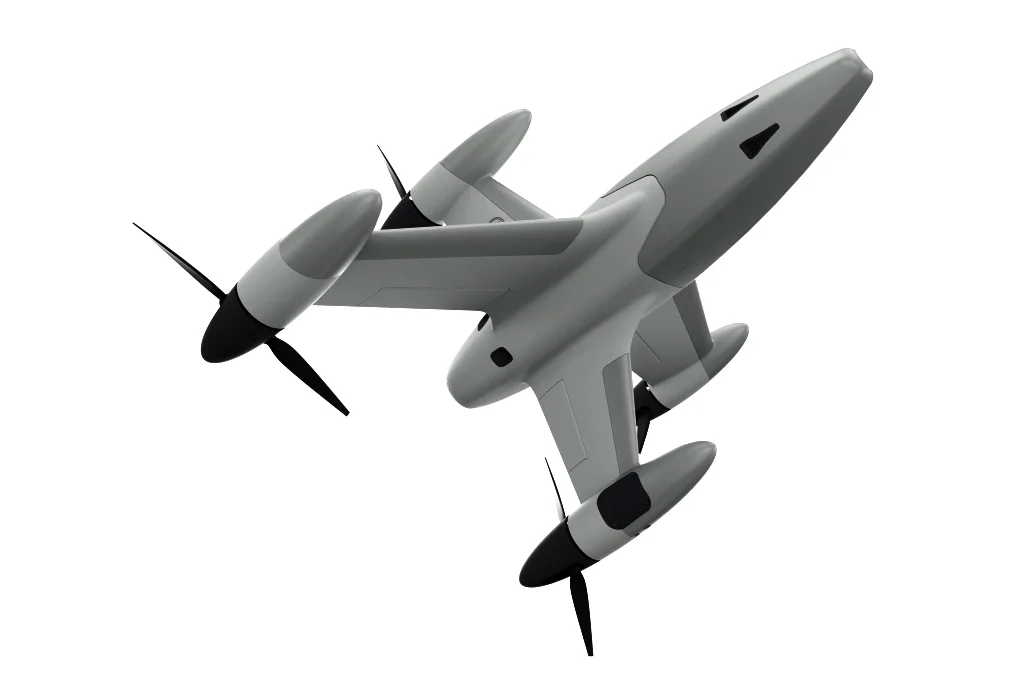
MARSS's medium-range hybrid VTOL interceptor that defeats drones head-on and can survive the impact to attack again.
- Range
- at least 5 km
- Speed
- at least 290 km/h
Sourced record, not yet reviewed. Compiled from the public sources listed below. Every figure is attributed to its source; where sources disagree, both values are shown. No editor has reviewed this record yet.
Overview
Interceptor MR is an AI-enabled autonomous interceptor from MARSS. It combines a fixed-wing airframe with four electric motors, takes off vertically from a canister launcher linked to the company's NiDAR command and sensor system, and hits Class I and II drones head-on.
Once the operator authorises the attack, the final approach is autonomous, guided by an uncooled infrared seeker in the nose. The motors stop and the propellers fold just before impact so the reinforced composite airframe can survive and restart; EDR Magazine reports a three-kill capability per sortie.
MARSS says the Interceptor MR completed flight testing of customer-driven upgrades ahead of a NATO evaluation.
Technical profile
Seeker, guidance, warhead, data link and launcher as described in public sources. Each line cites its source.
| Seeker | Uncooled infrared (imaging IR) seeker in the nose | Secondary reference[2][4] |
|---|---|---|
| Guidance | NiDAR cueing; autonomous terminal phase after operator authorisation, with NiDAR EDGE software and onboard AI | Manufacturer claim[1][3] |
| Warhead | No explosive or fuel; head-on ramming with a reinforced composite airframe | Manufacturer claim[1][3][4] |
| Motor / propulsion | Electric; 2024 redesign replaced four ducted fans with open propellers that stop and fold before impactThe MARSS product page still describes ducted propulsion. | Secondary reference[2][4] |
| Launcher | Vertical box canister (about 140 × 110 cm, electromagnetic cold launch); trailer option with six canisters | Secondary reference[2][4] |
| Launch and recovery | Can abort and return, or come down by parachute; reusable after some engagements against smaller drones | Manufacturer claim[3][4] |
| Fire control / radar | MARSS NiDAR C4I command-and-control and sensor system | Manufacturer claim[1][3] |
Publicly documented characteristics
Each figure shows where it comes from. “Not publicly disclosed” means no source we hold gives a figure; it is never treated as zero.
| Characteristic | Value | Evidence and sources |
|---|---|---|
| Speed (m/s) | At least 80 m/s | Manufacturer claim[1][2] |
| Maximum range (km) | At least 5 kmBasis: Maximum engagement range as claimed by the developer | Manufacturer claim[1] |
| Maximum altitude (km) | Up to 2 km | Manufacturer claim[1] |
| Mass (kg) | Up to 8 kgReported as just under 8 kg. | Secondary reference[2] |
| Length (m) | 0.8 m | Secondary reference[2] |
| Wingspan (m) | 0.9 m | Secondary reference[2] |
| Guidance / cueing | NiDAR cueing; onboard AI with uncooled IR seeker for the terminal phase | Manufacturer claim[1][2] |
| Launch / operating platform | Vertical smart launcher canisters, e.g. six-cell trailer | Secondary reference[2] |
Platforms and integration
Launchers, vehicles, ships, aircraft, sensors and command systems the record is integrated with, by status.
Development and tests
2026-06-15 · Development
MARSS joins EOS
Electro Optic Systems announced the acquisition of MARSS, which becomes an independent subsidiary; Interceptor MR shown at Eurosatory 2026. [5]
2025-09-16 · Test
Upgraded design flight-tested
UK flight trials of hardware and targeting-algorithm upgrades completed; selected for evaluation by a NATO member state; full production expected in 2026. [3]
2024 · Upgrade
Open-propeller redesign
Ducted fans replaced by folding open propellers, mass cut to about 8 kg, parachute and vertical landing added. [2][4]
2024 · Test
Fully autonomous flight
MARSS says the interceptor reached fully autonomous flight status in early 2024. [3]
2022-03 · Development
Interceptor MR first shown
First public display of the medium-range interceptor. [4]
Videos
Videos load from YouTube only when you press play. Official channels are marked.
Check out a high-speed drone that smashes enemy UAVs out of the sky with its nose
Military Times · 2025-09-21
Military Times feature on the MARSS Interceptor, which defeats drones by ramming them and keeps flying.
Watch on YouTubeMARSS Interceptor: designing the drone hunter
AeroTime · 2025-11-04
AeroTime episode on how MARSS designed its Interceptor drone hunter.
Watch on YouTubeCapabilities and limitations
Stated capabilities
- Over 80 m/s and altitudes up to 2 km (manufacturer).
- Head-on defeat from 5 km or more (manufacturer).
- Several kills per mission with the composite airframe (manufacturer; three according to specialist press).
Limitations and open questions
- MARSS's page still describes ducted propulsion; specialist press reports a switch to open propellers in 2024.
- Not yet confirmed in service with a named customer.
Relevance to threats
Listed by the strength of the evidence. Inclusion here is not a claim of proven effectiveness.
- One-way attack UAVsManufacturer claim
Class II drones at over 320 km/h are listed by the manufacturer.
- Payload-dropping multirotorsManufacturer claim
Micro and quad drones are listed by the manufacturer.
Sources
- 1.
INTERCEPTOR-MR (opens in a new tab)
MARSS · Manufacturer · Retrieved
Supports: Class I and II drones head-on from up to 5 km+; altitudes up to 2 km; over 80 m/s; vertical smart launcher linked to NiDAR; onboard AI imaging; multiple kills per mission
- 2.
WDS 2024 – MARSS Interceptor MR killer-drone close to production (opens in a new tab)
EDR Magazine · Specialist press · Retrieved
Supports: 800 mm length, 900 mm span, just under 8 kg; four electric motors with folding propellers; uncooled IR seeker; three-kill capability; six-cell trailer launcher
- 3.
MARSS · Manufacturer · Published · Retrieved
Supports: UK flight trials of upgraded design; selected for evaluation by a NATO member; full production expected in 2026; no explosives; recoverable by return or parachute; NiDAR EDGE onboard; fully autonomous flight early 2024
- 4.
MARSS Interceptor (opens in a new tab)
Wikipedia · Reference work (secondary) · Retrieved
Supports: MR first displayed March 2022; ramming kill; 2024 switch to open folding propellers, 8 kg; box canister with electromagnetic cold launch; trailer with six canisters and four AESA radar antennas; imaging infrared guidance
- 5.
Eurosatory 2026: MARSS, now part of EOS, sees Middle East air defence success (opens in a new tab)
Janes · Specialist press · Published · Retrieved
Supports: EOS acquisition announced 15 June 2026, MARSS an independent subsidiary; Interceptor MR shown at Eurosatory 2026
This record is compiled and kept up to date by World of Interceptors at www.worldofinterceptors.com/systems/marss-interceptor-mr. Cite it with a link to this page. Compiled from open sources and cross-checked, but accuracy cannot be guaranteed; manufacturers and independent organisations can ask us to correct or remove information (disclaimer).
Related systems
 © Anduril Industries
 © Nordic Air Defence
 © Fortem Technologies
Revision history
· Created
Record compiled from public sources found through treg web search.
· Update
Added profile, integrations and milestones from public sources; no contracts or named operators are public.
Newsletter · every two weeks
The Interceptors Brief
What changed in air defence and counter-drone, in five minutes, with the sources attached.
Confirm by email · unsubscribe in one click · Privacy