
Detection, Tracking & Command · Integrated counter-UAS systems
L-MADIS
Also known as Light Marine Air Defense Integrated System; LMADIS
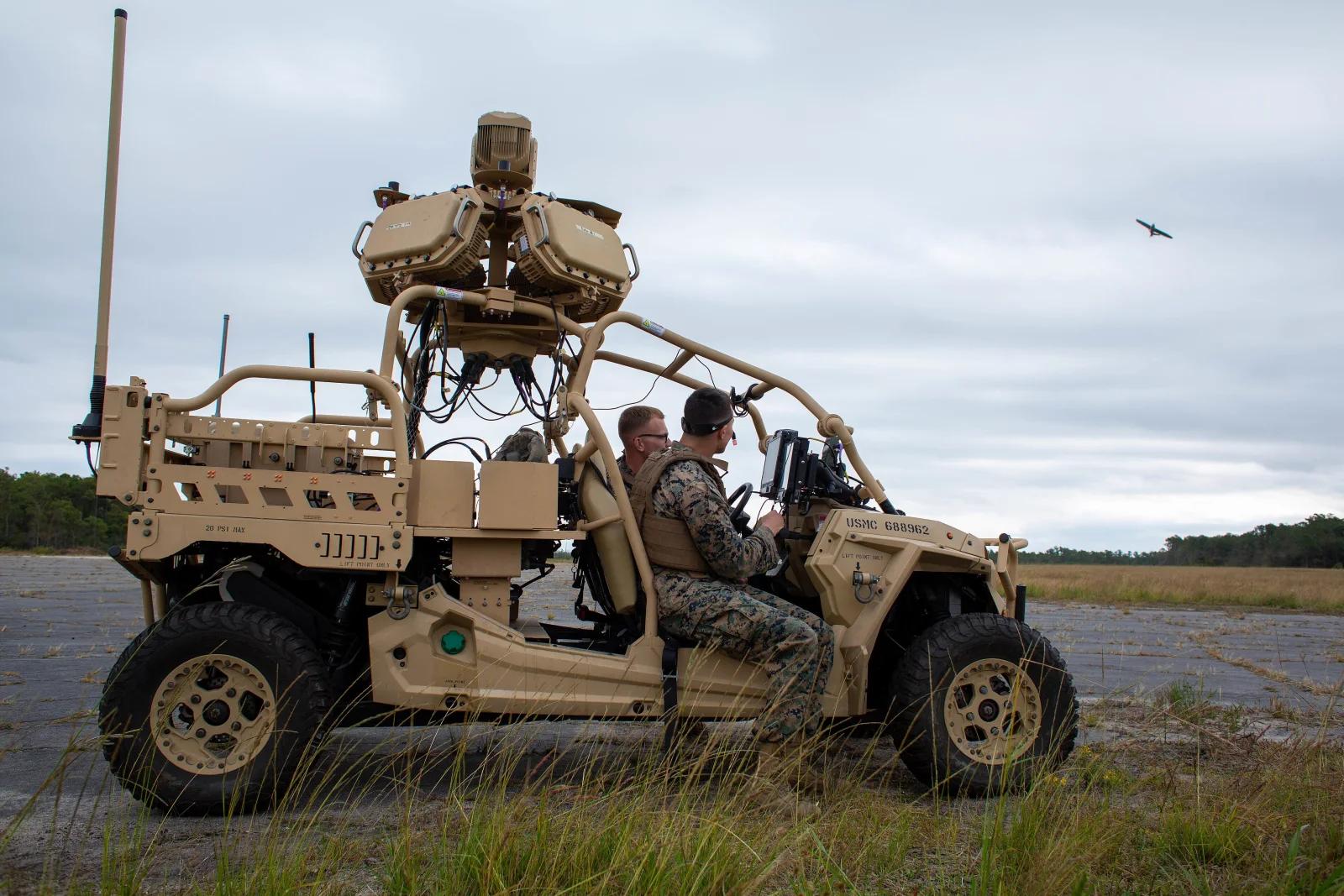
The U.S. Marine Corps' counter-drone kit on a Polaris MRZR buggy: radar and cameras find the drone, a jammer cuts its links. It was credited in 2019 with downing an Iranian drone from USS Boxer.
Sourced record, not yet reviewed. Compiled from the public sources listed below. Every figure is attributed to its source; where sources disagree, both values are shown. No editor has reviewed this record yet.
Enabling infrastructure. This record describes a sensor or command system. It does not engage targets itself.
Overview
L-MADIS puts a hemispheric radar, an electro-optical/infrared camera turret and an electronic-attack jammer on light MRZR vehicles that can be flown in or carried aboard ships. Marines use it to make drones drop, circle or fly home by disrupting their signals (government).
In July 2019 USS Boxer brought down an Iranian drone in the Strait of Hormuz. The Pentagon did not name the system; specialist press, citing Fox News, credited L-MADIS. Iran did not confirm the loss.
More images (1)

Technical profile
Seeker, guidance, warhead, data link and launcher as described in public sources. Each line cites its source.
| Antenna | DRS RADA hemispheric AESA radar: RPS-42 in 2019, later eCHR | Secondary reference[3][4] |
|---|---|---|
| Coverage | RPS-42 panels cover 90° each in azimuth, -10° to +70° elevation, to 30 km (radar datasheet; no system figure) | Manufacturer claim[7] |
| Target classes | Small UAS; jammed drones made to drop, circle or return home | Official document[1][2] |
| Mobility | Two Polaris MRZR light vehicles; air-transportable; used from amphibious ship decks; now on Ultra Light Tactical Vehicles | Official document[2][3][5][6] |
Publicly documented characteristics
Each figure shows where it comes from. “Not publicly disclosed” means no source we hold gives a figure; it is never treated as zero.
| Characteristic | Value | Evidence and sources |
|---|---|---|
| Detection range (km) | Not publicly disclosedNot published for the integrated system. | |
| Guidance / cueing | DRS RADA hemispheric radar and EO/IR turret | Secondary reference[3][4] |
| Effect | Electronic attack: drones made to drop, circle or return home | Official document[2][1] |
| Launch / operating platform | Polaris MRZR light vehicles | Secondary reference[3][4] |
Platforms and integration
Launchers, vehicles, ships, aircraft, sensors and command systems the record is integrated with, by status.
| Platform or system | Domain | Status | Sources |
|---|---|---|---|
| Polaris MRZR | Land | In service | [3] |
| Ultra Light Tactical Vehicle (ULTV)Received by 2nd LAAD Battalion in April 2026. | Land | In service | [5][6] |
| Amphibious assault ships (USS Boxer, USS America) | Naval | In service | [2][3] |
| DRS RADA hemispheric radar | Sensor / C2 | In service | [3][4] |
Operators
Development and tests
2026-04-08 · First delivery
L-MADIS on ULTV fielded
2nd LAAD Battalion received Ultra Light Tactical Vehicles and L-MADIS at MCAS Cherry Point. [6]
2023-07 · Development
Programme of record in development
After limited rapid-acquisition fielding, L-MADIS entered engineering and manufacturing development; US$33 million requested for FY2024. [5]
2019-07-18 · Reported combat use
Iranian drone near USS Boxer
According to The War Zone, citing Fox News, L-MADIS brought down an Iranian drone in the Strait of Hormuz; the Pentagon did not name the system. [3]
Capabilities and limitations
Stated capabilities
- Non-kinetic electronic attack against drone control links (government).
- Two-vehicle set in 2019: RPS-42 radars, a CM202 EO/IR turret and a jammer (specialist press).
- Air-transportable and used from amphibious ships' decks (government).
Limitations and open questions
- Jamming does not stop drones that fly without a radio link; Marines keep Stinger missiles as a kinetic backup (specialist press).
- The radar fit has changed over time; DRS says later MADIS and L-MADIS use its eCHR radar.
Relevance to threats
Listed by the strength of the evidence. Inclusion here is not a claim of proven effectiveness.
- One-way attack UAVsIndependent operational report
Credited by specialist press with downing an Iranian fixed-wing drone near USS Boxer in July 2019; the Pentagon did not name the system.
- Payload-dropping multirotorsOfficial document
Marine Corps imagery shows routine drone-jamming training.
Related records
- IntegratesMHR / ieMHRDetection & command
Sources
- 1.
Death from Below: L-MADIS (opens in a new tab)
U.S. Marine Corps (DVIDS) · Government · Published · Retrieved
Supports: 2nd LAAD Battalion Marines using L-MADIS to jam a drone; non-kinetic electronic attack
- 2.
31st MEU L-MADIS UTV (opens in a new tab)
U.S. Marine Corps (DVIDS) · Government · Published · Retrieved
Supports: L-MADIS aboard USS America; can make drones drop, circle or return home by disrupting their signals
- 3.
Marine anti-drone buggies on USS Boxer knocked down 'threatening' Iranian drone (opens in a new tab)
The War Zone · Specialist press · Published · Retrieved
Supports: Two Polaris MRZRs with RADA RPS-42 radars, CM202 EO/IR turret and Modi jammer; credited (per Fox News) with downing an Iranian drone on 18 July 2019; Pentagon did not name the system
- 4.
Radar: the key to counter-UAS and C-RAM defense (opens in a new tab)
Breaking Defense (sponsored by Leonardo DRS) · Specialist press · Retrieved
Supports: DRS RADA radars on Stryker M-SHORAD; ieMHR is S-band AESA with GaN; eCHR used on MADIS and L-MADIS; radars built in Germantown, Maryland. Sponsored content.
- 5.
DefenseScoop · Specialist press · Published · Retrieved
Supports: L-MADIS first fielded in limited quantities under rapid acquisition; entering EMD; USD 33 million requested for FY2024; to be integrated on ultra-light tactical vehicles
- 6.
U.S. Marines with 2nd LAAD receive ULTVs and LMADIS systems (opens in a new tab)
U.S. Marine Corps (DVIDS) · Government · Published · Retrieved
Supports: 2nd LAAD Battalion received Ultra Light Tactical Vehicles and L-MADIS at MCAS Cherry Point on 8 April 2026
- 7.
Multi-Mission Hemispheric Radar (MHR) family of software defined radar systems (opens in a new tab)
Leonardo DRS · Manufacturer · Published · Retrieved
Supports: S-band AESA; 90° azimuth per panel, 360° with four; 23 kg per panel, 105 kg for four; RPS-42 air surveillance to 30 km, -10° to +70° elevation
This record is compiled and kept up to date by World of Interceptors at www.worldofinterceptors.com/systems/l-madis. Cite it with a link to this page. Compiled from open sources and cross-checked, but accuracy cannot be guaranteed; manufacturers and independent organisations can ask us to correct or remove information (disclaimer).
Related systems
 © Rafael Advanced Defense Systems

 © DroneShield
Revision history
· Created
Record compiled from public sources found through treg web search.
· Update
Added profile, integrations, operator and milestones from public sources.
Newsletter · every two weeks
The Interceptors Brief
What changed in air defence and counter-drone, in five minutes, with the sources attached.
Confirm by email · unsubscribe in one click · Privacy