Interceptor Drones · Explosive or fragmentation-effect interceptors
Coyote Block 2
Also known as Coyote; Coyote 2C; Coyote Block 2C
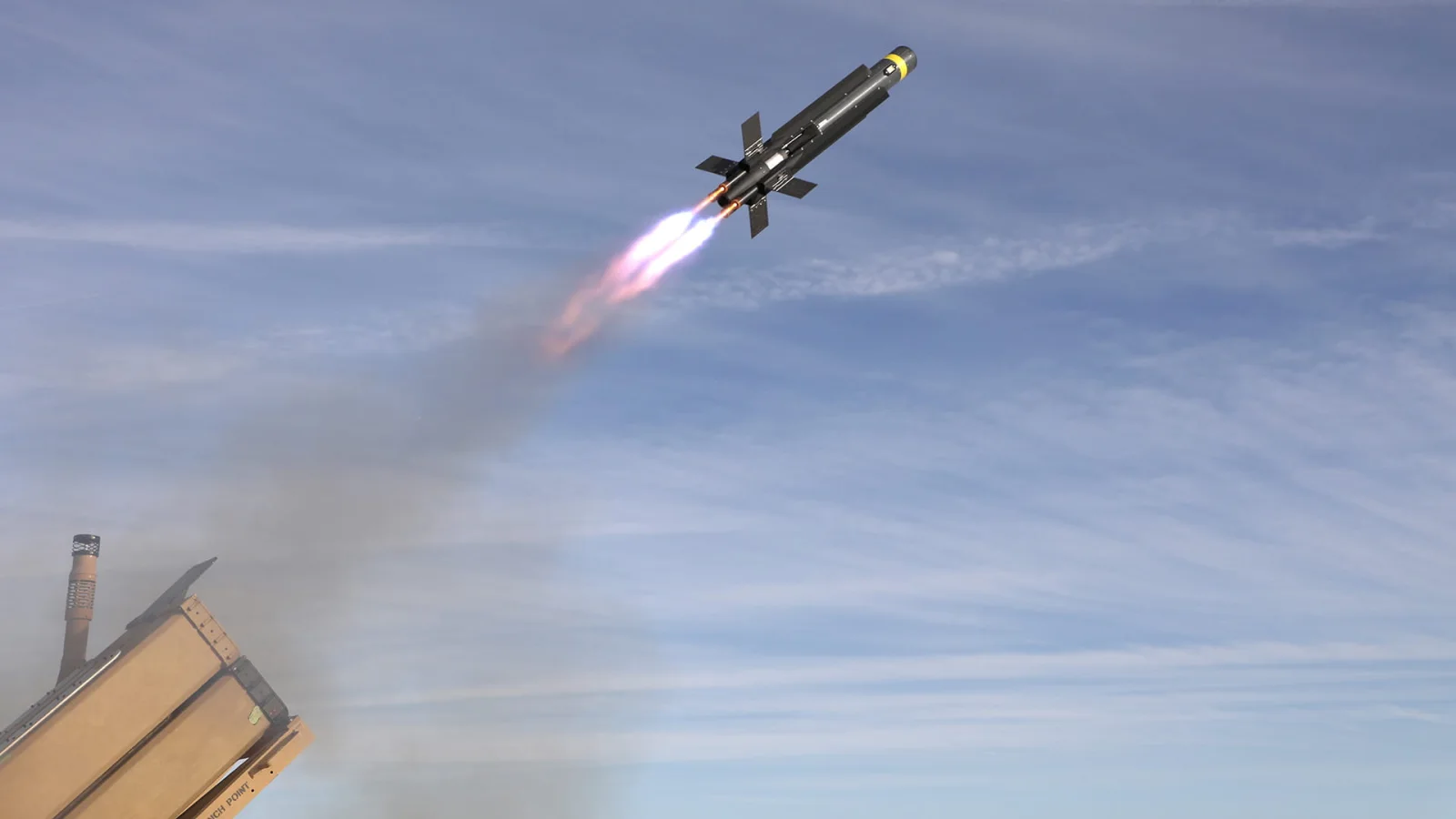
RTX's rail-launched, turbine-powered counter-drone interceptor and the kinetic effector of the U.S. Army's LIDS system: Block 2 flies at about 555–595 km/h out to 10–15 km and costs roughly $100,000–125,000 a round. Block 2C+RM adds a rocket motor; Block 3 is a recoverable, non-kinetic version.
- Range
- 10–15 km
- Speed
- 555–595 km/h
- Reported unit cost
- about $100,000
Sourced record, not yet reviewed. Compiled from the public sources listed below. Every figure is attributed to its source; where sources disagree, both values are shown. No editor has reviewed this record yet.
Overview
Coyote is a small expendable air vehicle made by Raytheon (RTX). The Block 2 interceptor is launched by a boost motor and then flies on a small turbine engine; RTX describes it as a low-cost, rail-launched effector that works from fixed sites and vehicles.
In U.S. Army service it is paired with the Ku-band Radio Frequency Sensor (KuRFS) radar in the Low, slow, small-unmanned aircraft Integrated Defeat System (LIDS). The Army bought 600 'Coyote 2C' interceptors for $75 million in January 2024 under rapid acquisition authority.
RTX says Block 2 has intercepted hundreds of drones. A newer Block 2C+RM replaces the turbine with a rocket motor and adds a new seeker and warhead; a non-kinetic Block 3NK can loiter and be recovered.
Technical profile
Seeker, guidance, warhead, data link and launcher as described in public sources. Each line cites its source.
| Seeker | RF seeker since Block 1B; Block 2C+RM adds a new seeker (type not published) | Secondary reference[1][3] |
|---|---|---|
| Guidance | Semi-active guided airframe, cued and guided from the ground by the KuRFS radar | Official document[2][7] |
| Warhead | Proximity blast-fragmentation warhead with ESAD fuze and terminal air arming; Block 3NK carries a non-kinetic payloadDefence Industry Europe describes the Block 3NK payload as a high-power microwave module. | Official document[1][7] |
| Motor / propulsion | Boost rocket motor, then a small turbine engine; Block 2C+RM replaces the turbine with a rocket motor | Manufacturer claim[1] |
| Launcher | Rail launch; FS-LIDS uses a four-round (4-pack) launcher, M-LIDS a two-round launcher on an M-ATV | Official document[3][7] |
| Launch and recovery | Block 2 is expendable; Block 3NK can loiter, be recalled, serviced and relaunched | Manufacturer claim[1][8] |
| Fire control / radar | KuRFS 360° Ku-band AESA radar with Northrop Grumman FAAD C2 in the Army's LIDS family | Secondary reference[1][8] |
Publicly documented characteristics
Each figure shows where it comes from. “Not publicly disclosed” means no source we hold gives a figure; it is never treated as zero.
| Characteristic | Value | Evidence and sources |
|---|---|---|
| Speed (m/s) | 154–165 m/s555–595 km/h. | Secondary reference[3] |
| Maximum range (km) | 10–15 kmBasis: Range reported in secondary sources | Secondary reference[3] |
| Reported unit cost (USD) | ≈ $100,000Estimate tied to the Army's planned multi-year purchase. | Secondary reference[3] |
| Guidance / cueing | Ground-launched, radar-guided; cued by KuRFS in LIDS | Official document[2][1] |
| Effect | Kinetic warhead producing a fragment field | Manufacturer claim[1][3] |
| Launch / operating platform | Rail launcher on fixed sites and vehicles | Manufacturer claim[1] |
| Endurance (min) | Up to 4 minBlock 2 can stay airborne for up to four minutes. | Secondary reference[3] |
Platforms and integration
Launchers, vehicles, ships, aircraft, sensors and command systems the record is integrated with, by status.
| Platform or system | Domain | Status | Sources |
|---|---|---|---|
| M-LIDS on M-ATV, two-round launcher · United States | Land | In service | [3] |
| Marine Corps GBAD on M-ATV or MRZR · United StatesBlock 1 interceptor with the RPS-42 radar, per a reference work. | Land | In service | [3] |
| U.S. Navy destroyers (4-cell and 8-cell Coyote launchers) · United StatesLaunchers for Block 3 / Coyote, per a reference work. | Naval | In service | [3] |
| FS-LIDS (fixed-site LIDS), four-round launcher · United States | Fixed site | In service | [3][8] |
| FS-LIDS for Qatar · QatarPossible FMS notified in 2022 (Transmittal 22-36). | Fixed site | Ordered | [6] |
| FS-LIDS for the UAE · United Arab EmiratesPossible FMS notified in March 2026 (Transmittal 25-70). | Fixed site | Ordered | [7] |
| KuRFS Ku-band radar | Sensor / C2 | In service | [1][8] |
| FAAD C2 · United States | Sensor / C2 | In service | [8] |
Operators
Contracts and orders
Publicly announced contracts, newest first. Values and quantities are as reported; currencies are not converted.
| Date | Customer · contract | Quantity | Value | Sources |
|---|---|---|---|---|
| United Arab Emirates (FMS)Possible sale of ten FS-LIDS with Coyote 4-pack launchers, KuMRFS radars and EO/IR cameras (Transmittal 25-70); value covers the whole package | 240 Coyote Block 2 all-up rounds | US$2.10 billion | [7] | |
| U.S. Army (Army Contracting Command, Redstone Arsenal) · RaytheonCost-plus-fixed-fee contract W31P4Q-25-D-0013 for the Coyote Missile System: fixed and mobile launchers, kinetic and non-kinetic interceptors and Ku-band radio frequency system radars; one bid; work to 28 September 2033 | — | US$5,039,629,681 | [5][11] | |
| U.S. Army (Army Contracting Command, Redstone Arsenal) · RaytheonCost-plus-fixed-fee contract W31P4Q-24-C-0018 for Coyote interceptors, fully obligated at award; completion 30 September 2027; quantities not announced | — | US$196,719,957 | [4][12] | |
| U.S. ArmyCoyote 2C interceptors under rapid acquisition authority | 600 interceptors | US$75 million | [2] | |
| Qatar (FMS)Possible sale of ten FS-LIDS with Coyote launchers and KuMRFS radars (Transmittal 22-36), printed in the Congressional Record | 200 Coyote Block 2 interceptors | US$1.0 billion | [6] |
Production and deliveries
Reported production, delivery and order figures by period. Gaps mean no public figure, not zero.
| Period | Figure | Quantity | Sources |
|---|---|---|---|
| FY2025–FY2029 | Planned rate | at least 6,000 kinetic and 700 non-kinetic interceptorsArmy requirement in a December 2023 notice, with 252 fixed-site and 25 mobile launchers. | [4] |
| by end of 2027 | Planned rate | about 300 a monthRaytheon said in July 2026 it had tripled output over the past year and planned to double it again by the end of next year. | [9] |
| 2024 | Ordered | 600Coyote 2C, January 2024 rapid acquisition. | [2] |
Development and tests
2026-07 · Reported combat use
600 combat intercepts disclosed
According to Defence Industry Europe, the U.S. Army approved disclosure of 600 combat intercepts since deployment; the system was used in Operation Epic Fury. [9]
2026-02 · Test
Block 3NK swarm demonstration
RTX demonstrated the recoverable, non-kinetic Block 3NK against drone swarms in a U.S. Army demonstration. [8]
2024-01-16 · Production
600 Coyote 2C ordered
The Army bought 600 Coyote 2C interceptors for $75 million under rapid acquisition authority. [2]
2020-03-17 · Development
Cleared for export
Raytheon was cleared to sell Coyote Block 2 internationally, according to a reference work. [3]
2019-06 · Development
KuRFS and Coyote reach IOC
The KuRFS radar and Coyote combination reached initial operational capability, according to a reference work. [3]
2018-07 · Upgrade
Block 1B with RF seeker
Block 1B contract for counter-UAS missions, with a radio-frequency seeker and proximity warhead paired with KuRFS. [3]
2015 · Development
Raytheon acquires Sensintel
Raytheon bought Sensintel, the Tucson firm behind the original Coyote air vehicle, and began counter-UAS work with the Army in 2016. [3]
Videos
Videos load from YouTube only when you press play. Official channels are marked.
Raytheon’s Coyote Block 3NK defeats drone swarms with non-kinetic effect
RTXOfficial channel · 2026-02-11
RTX video of the recoverable Coyote Block 3NK variant engaging drone swarm targets with a non-kinetic payload.
Watch on YouTubeCapabilities and limitations
Stated capabilities
- Speed of about 555–595 km/h and engagement range of 10–15 km (reference work).
- Warhead that throws a fragment field suited to small drones (reference work); RTX calls it a kinetic warhead.
- Can re-attack after a miss (reference work).
Limitations and open questions
- Single-use: each engagement expends an interceptor costing about $100,000 (reference-work estimate).
- RTX publishes no speed or range figures for Block 2; the numbers here are secondary.
Relevance to threats
Listed by the strength of the evidence. Inclusion here is not a claim of proven effectiveness.
- One-way attack UAVsManufacturer claim
RTX says Block 2 has intercepted hundreds of drones; details of the targets are not public.
- Shahed-136 / Geran familySecondary reference
A reference work cites Raytheon reporting 600 combat intercepts by Coyote during Operation Epic Fury (2026); the targets are not broken down.
Frequently asked questions
Short answers drawn from the sources below. Where sources disagree, the answer gives the range.
How much does a Coyote interceptor cost?
About $100,000 to $125,000 each. The War Zone and a reference work put a Block 2 at about $100,000. The Army's January 2024 order of 600 Coyote 2C for $75 million works out at about $125,000 each (our arithmetic; the award may include more than the rounds). [2][3][10]
What is the difference between Coyote Block 2, Block 2C and Block 3?
Block 2 is the jet-powered kinetic interceptor: boosted off a rail, then flown on a small turbine with a radar seeker and a fragmentation warhead, and used once. Coyote 2C is the version the Army ordered in 2024; Block 2C+RM swaps the turbine for a rocket motor with a new seeker and warhead. Block 3 is built on the original propeller-driven Coyote airframe, carries a non-kinetic payload (Block 3NK) and can be recovered, serviced and relaunched. [1][2][8][10]
How fast is Coyote and what is its range?
A reference work gives Block 2 a speed of about 555–595 km/h, an engagement range of 10–15 km and up to four minutes in the air. RTX does not publish these figures. [1][3]
Who uses Coyote and what contracts exist?
The U.S. Army, Navy and Marine Corps. The Army awarded about $5 billion in September 2025 for launchers, kinetic and non-kinetic interceptors and radars to 2033, after $75 million (600 rounds) in January 2024 and $197 million in September 2024. Qatar (200 rounds, $1.0 billion package, 2022) and the UAE (240 rounds, $2.10 billion package, 2026) were cleared to buy FS-LIDS. [2][3][4][5][6][7]
How many Coyotes is the U.S. Army buying, and how many have been used?
A 2023 Army notice planned 6,000 Block 2 and 700 Block 3 interceptors for FY2025–2029. Raytheon said in July 2026 it had tripled output in a year and planned about 300 a month by the end of 2027; the Army approved disclosure of 600 combat intercepts. [4][9][10]
Sources
- 1.
Coyote C-UAS (opens in a new tab)
RTX (Raytheon) · Manufacturer · Retrieved
Supports: Kinetic Block 2, boost motor plus turbine engine, rail launch, KuRFS and LIDS pairing, 'intercepted hundreds of drones', Block 2C+RM rocket-motor upgrade
- 2.
Army announces rapid acquisition authority contract for Coyote interceptors (opens in a new tab)
U.S. Army · Government · Published · Retrieved
Supports: $75 million contract for 600 Coyote 2C interceptors awarded 16 January 2024; ground-launched, radar-guided, kinetic and non-kinetic variants
- 3.
Raytheon Coyote (opens in a new tab)
Wikipedia · Reference work (secondary) · Retrieved
Supports: Block 2 speed 555–595 km/h, 10–15 km engagement range, fragmentation warhead, planned buy of 6,000, about $100,000 each
- 4.
Army awards contract for Coyote interceptors to Raytheon (opens in a new tab)
DefenseScoop · Specialist press · Published · Retrieved
Supports: $197 million cost-plus-fixed-fee award announced 26 September 2024, completion 30 September 2027; FY2025–2029 requirement for at least 6,000 kinetic and 700 non-kinetic interceptors, 252 fixed and 25 mobile launchers; fielded mainly to CENTCOM
- 5.
US Army awards Raytheon $5 billion Coyote contract (opens in a new tab)
The Defense Post · Specialist press · Published · Retrieved
Supports: About $5 billion award for fixed and mobile launchers, kinetic and non-kinetic interceptors and Ku-band radars; work to 28 September 2033
- 6.
Arms Sales Notification, Transmittal No. 22-36 (Qatar FS-LIDS) (opens in a new tab)
U.S. Congressional Record (govinfo) · Government · Published · Retrieved
Supports: Possible sale to Qatar of ten FS-LIDS with 200 Coyote Block 2 interceptors, Coyote launchers and KuMRFS radars; estimated $1.0 billion; Coyote described as a kinetic C-UAS missile
- 7.
Arms Sales Notification, Transmittal No. 25-70 (United Arab Emirates FS-LIDS) (opens in a new tab)
Federal Register (govinfo) · Government · Published · Retrieved
Supports: Delivered to Congress 19 March 2026: ten FS-LIDS, 240 Coyote Block 2 all-up rounds, 4-pack launchers, KuMRFS radars, $2.10 billion; annex: semi-active guided airframe, proximity blast-fragmentation warhead, ESAD fuze
- 8.
Army Recognition · Specialist press · Published · Retrieved
Supports: Planned FY2027 multi-year framework with RTX; Block 3NK demonstrated against swarms in February 2026; KuRFS AESA radar and Northrop Grumman FAAD C2; about $120,000 per shot (Bloomberg)
- 9.
Defence Industry Europe · Specialist press · Published · Retrieved
Supports: Production tripled in a year, plan to double again to about 300 a month; Army approved disclosure of 600 combat intercepts; Block 3NK high-power microwave module
- 10.
Drastic Increase In Army Coyote Drone Interceptor Purchase Plans (opens in a new tab)
The War Zone · Specialist press · Published · Retrieved
Supports: Army plan for 6,000 Block 2 and 700 non-kinetic Block 3 interceptors in FY2025–2029; Block 2 reportedly about $100,000 each; Block 2 jet-powered with radar seeker and single-use; Block 3 based on the propeller-driven Block 1 airframe, recoverable and reusable; M-LIDS two-round and FS-LIDS four-round launchers
- 11.
Contracts For Sep. 29, 2025 (opens in a new tab)
U.S. Department of War · Government · Published · Retrieved
Supports: Raytheon Co., Tucson, cost-plus-fixed-fee contract for the Coyote Missile System (fixed and mobile launchers, kinetic and non-kinetic interceptors, Ku-band radio frequency system radars), $5,039,629,681; one bid; completion 28 September 2033; Army Contracting Command, Redstone Arsenal (W31P4Q-25-D-0013)
- 12.
Contracts For Sep. 26, 2024 (opens in a new tab)
U.S. Department of Defense · Government · Published · Retrieved
Supports: Raytheon Co., El Segundo, $196,719,957 cost-plus-fixed-fee contract for Coyote interceptors; one bid; work in Dulles, Virginia, completion 30 September 2027; Army Contracting Command, Redstone Arsenal (W31P4Q-24-C-0018)
This record is compiled and kept up to date by World of Interceptors at www.worldofinterceptors.com/systems/coyote-block-2. Cite it with a link to this page. Compiled from open sources and cross-checked, but accuracy cannot be guaranteed; manufacturers and independent organisations can ask us to correct or remove information (disclaimer).
Related systems
 © Anduril Industries
 © Cambridge Aerospace (published via Army Recognition)
Revision history
· Created
Record compiled from public sources found through treg web search.
· Update
Added profile, integrations, operators, contracts (Army awards, Qatar and UAE FMS), production plans, milestones and an RTX video from public sources.
· Update
Added a figure-led summary, a search title and a sourced FAQ on price, variants (Block 2, 2C, 2C+RM, Block 3), performance and contracts.
· Correction
Contracts audit: the two Army Coyote awards now cite the War Department contract announcements. September 2025 award dated 29 September 2025 with the official value US$5,039,629,681 and contract number W31P4Q-25-D-0013 (was 'about US$5 billion', September 2025); September 2024 award value corrected to the announced US$196,719,957 (was US$197 million) with contract number W31P4Q-24-C-0018.
Newsletter · every two weeks
The Interceptors Brief
What changed in air defence and counter-drone, in five minutes, with the sources attached.
Confirm by email · unsubscribe in one click · Privacy