Interceptor Missiles · Short-range air-defense missiles
2K22 Tunguska
Also known as Tunguska; Tunguska-M; Tunguska-M1; 2K22M; 2K22M1; 2S6; 2S6M; 2S6M1; SA-19 Grison; 9M311
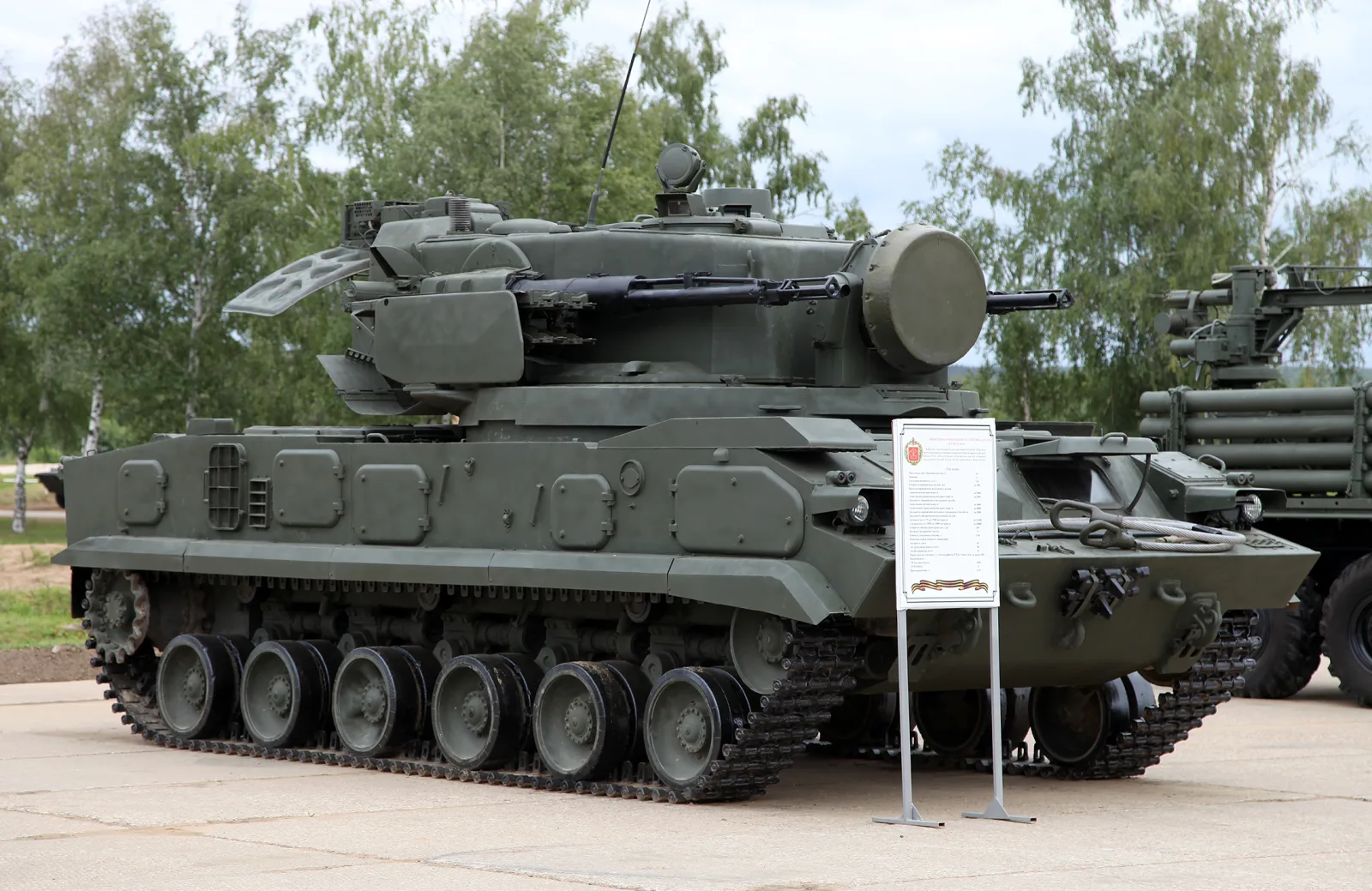
KBP's tracked Russian gun-missile air defence vehicle, in service since the 1980s: two twin 30 mm cannon firing up to 5,000 rounds a minute plus eight 9M311 radio-command missiles reaching about 8 km (10 km for the 9M311-M1 of the Tunguska-M1).
- Range
- 8 km
- Speed
- about 3,240 km/h
Sourced record, not yet reviewed. Compiled from the public sources listed below. Every figure is attributed to its source; where sources disagree, both values are shown. No editor has reviewed this record yet.
Overview
The 2K22 Tunguska (NATO SA-19 Grison) is a self-propelled air defence system that combines guns and missiles on one tracked vehicle. Its origins lie in a 1970 requirement to replace the ZSU-23-4 Shilka gun vehicle, and it was designed by the KBP Instrument Design Bureau, which later developed the Pantsir-S1 on the same concept. It is meant to protect tank and motorised units from low-flying aircraft, helicopters and some cruise missiles, and can also fire at light armour and troops.
The 2S6 combat vehicle carries two twin 30 mm 2A38 cannon, one each side of the turret, with a combined rate of fire between 1,950 and 5,000 rounds a minute, and a bank of 9M311 missiles beside each gun. The 9M311 is a two-stage, radio-command-guided missile: Air Power Australia gives a booster that accelerates it to about 900 m/s and a sustainer that holds about 600 m/s to impact. Army Recognition gives an engagement zone of 2.4–8 km slant range and 15–3,500 m altitude against targets moving at up to 500 m/s. A surveillance radar detects targets out to 18 km and a tracking radar follows them from 16 km; together they form the 1RL144M set. The vehicle weighs about 34 tonnes, has a crew of four and runs on the GM-352M tracked chassis also used by Buk and Tor.
The first version carried four missiles. Air Power Australia dates its initial operational capability to 1982, while Army Recognition says it entered service in 1986. The 2S6M (Tunguska-M), with eight missiles, followed in 1990. The Tunguska-M1 of 2003 moved to the GM-5975 chassis and added a digital link to the Ranzhir automated command system, an upgraded fire-control radar and software, automatic optical tracking and the 9M311-M1 missile, whose range rises to 10 km and whose laser proximity fuze was replaced by a radio fuze to engage small targets such as cruise missiles. Older vehicles can be upgraded to that standard; 21 Tunguska-M1 systems were delivered in 2012–2017 (U.S. Army Worldwide Equipment Guide).
A typical battery has six combat vehicles with reload vehicles (2F77M transloaders), maintenance vehicles and training aids, according to Army Recognition, which lists Belarus, India, Morocco, Russia and Ukraine among the system's users. Its high-speed missile and gun combination was the basis for KBP's later Pantsir-S1, whose 57E6 missile Air Power Australia describes as derived from the Tunguska's 9M311 series.
Technical profile
Seeker, guidance, warhead, data link and launcher as described in public sources. Each line cites its source.
| Guidance | Radio command (command to line of sight) with radar or optical tracking | Secondary reference[2][3] |
|---|---|---|
| Fuze | Laser proximity fuze on the 9M311; radio proximity fuze on the 9M311-M1 | Official document[1] |
| Motor / propulsion | Two-stage 9M311 with a separable solid-propellant booster | Secondary reference[2][3] |
| Rounds per launcher | 8 missiles and two twin 30 mm cannon (HE-T and HE-I ammunition) | Secondary reference[2] |
| Fire control / radar | 1RL144M radar set: E-band surveillance radar (18 km) and J-band tracking radar (16 km); Ranzhir C2 link on the Tunguska-M1 | Secondary reference[1][2] |
| Crew | Four: driver, commander, gunner and radar operator | Secondary reference[2] |
Publicly documented characteristics
Each figure shows where it comes from. “Not publicly disclosed” means no source we hold gives a figure; it is never treated as zero.
| Characteristic | Value | Evidence and sources |
|---|---|---|
| Maximum range (km) | 8 kmBasis: Range reported in secondary sources9M311 slant range; the 9M311-M1 of the Tunguska-M1 reaches 10 km (U.S. Army reference). | Secondary reference[2] |
| Minimum range (km) | 2.4 kmMissile; the guns cover the closer zone. | Secondary reference[2] |
| Maximum altitude (km) | 3.5 kmMissile engagement from 15 m to 3,500 m. | Secondary reference[2] |
| Calibre (mm) | 30 mmTwo twin-barrel 2A38 (2A38M) cannon. | Secondary reference[2] |
| Ready rounds / magazine | 8 ready 9M311 missiles (4 on the original 2S6) | Official document[1][2] |
| Guidance / cueing | Radio command guidance from radar or optical tracking | Secondary reference[2][3] |
| Speed (m/s) | ≈ 900 m/s9M311 at booster burnout; the sustainer stage holds about 600 m/s. | Secondary reference[3] |
| Detection range (km) | 18 kmSurveillance radar against aircraft-sized targets; tracking radar 16 km. Not a small-UAS figure. | Secondary reference[2] |
| Mass (kg) | 34,000 kgCombat vehicle. | Secondary reference[2] |
| Launch / operating platform | GM-352M tracked chassis (GM-5975 on the Tunguska-M1) | Secondary reference[2][1] |
Operators
Production and deliveries
Reported production, delivery and order figures by period. Gaps mean no public figure, not zero.
| Period | Figure | Quantity | Sources |
|---|---|---|---|
| 2012–2017 | Delivered | 21 Tunguska-M1 | [1] |
Development and tests
2003 · Upgrade
Tunguska-M1 enters service
GM-5975 chassis, Ranzhir C2 link, upgraded fire control and the 10 km 9M311-M1 missile. [1][3]
1990 · Upgrade
Tunguska-M
1982 · First delivery
Initial operational capability
Air Power Australia dates IOC of the four-missile 2S6 to 1982; Army Recognition gives entry into service in 1986. [2][3]
1970 · Development
Requirement issued
Directive for a replacement for the ZSU-23-4 self-propelled gun. [2][3]
Capabilities and limitations
Stated capabilities
- Guns and missiles on one vehicle: two twin 30 mm cannon (1,950–5,000 rounds a minute) and eight 9M311 missiles (specialist press).
- Missile engagement out to about 8 km slant range and 3.5 km altitude; 10 km with the 9M311-M1 (specialist press; U.S. Army reference).
- Onboard surveillance and tracking radars (18 km and 16 km) with an optical channel (specialist press).
Limitations and open questions
- Short range compared with dedicated missile systems; designed for low-flying aircraft and helicopters rather than ballistic targets.
- Radio-command guidance ties each engagement to the vehicle's own tracking (specialist press).
- Published figures come from export literature and secondary sources and vary slightly between them.
Relevance to threats
Listed by the strength of the evidence. Inclusion here is not a claim of proven effectiveness.
- Cruise missilesOfficial document
The 9M311-M1's radio fuze is meant for small targets such as cruise missiles (U.S. Army reference).
Frequently asked questions
Short answers drawn from the sources below. Where sources disagree, the answer gives the range.
What is the range of the 2K22 Tunguska?
About 8 km slant range for the 9M311 missile, from 15 m up to 3,500 m altitude, and 10 km for the 9M311-M1 used by the Tunguska-M1. The 30 mm guns cover the closer zone; the crossover between guns and missiles is quoted at up to 4 km. [1][2]
How fast does the Tunguska fire?
Its two twin 30 mm 2A38 cannon together fire between 1,950 and 5,000 rounds a minute, using high-explosive tracer and high-explosive incendiary rounds with impact/time fuzes. [2]
What is the difference between Tunguska and Pantsir?
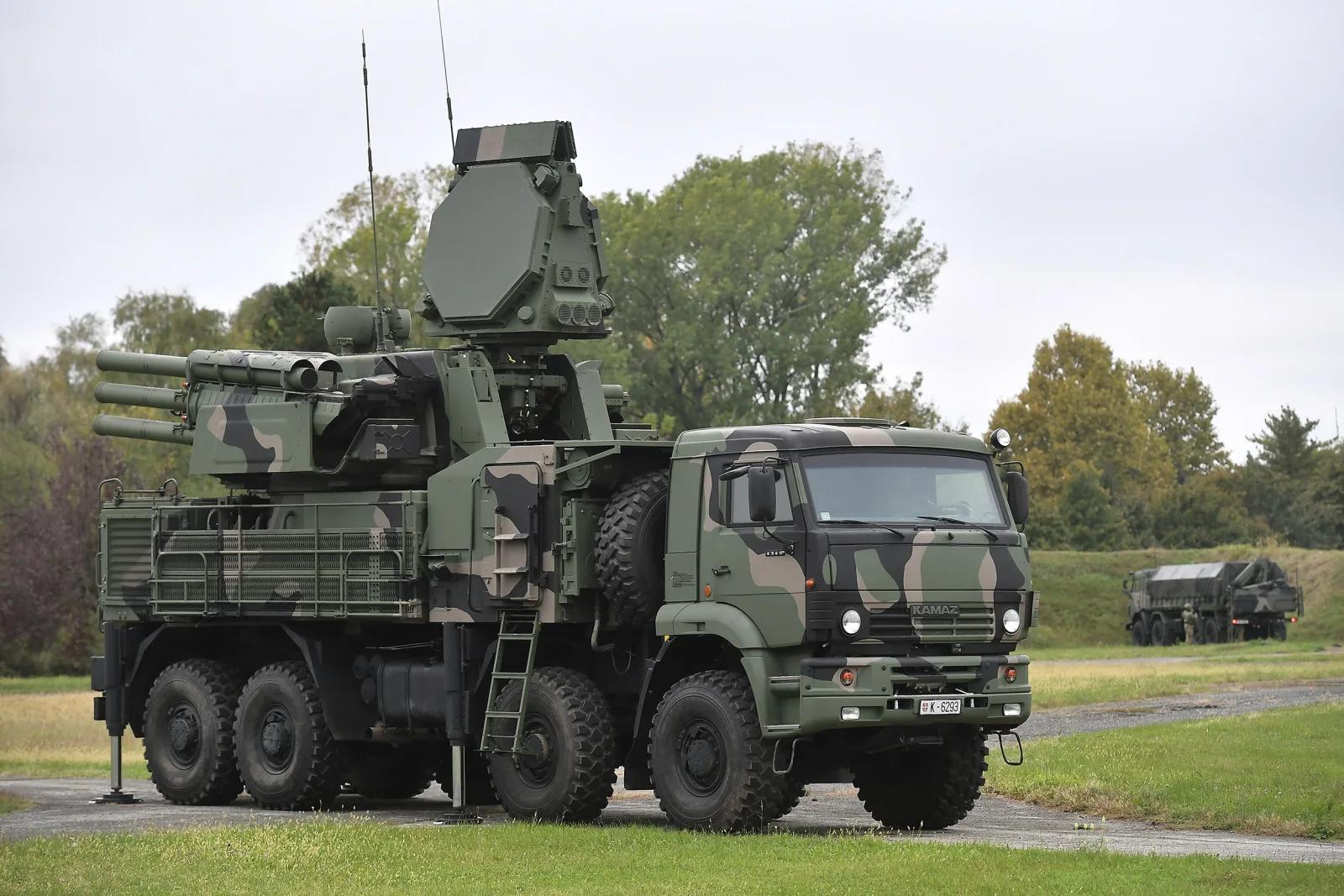
Both come from KBP and combine 30 mm guns with command-guided missiles. The Tunguska is a tracked army vehicle with eight 9M311 missiles reaching about 8–10 km; the Pantsir-S1 carries up to twelve 57E6 missiles derived from the 9M311, with a more powerful booster and about 20 km range. [2][3][4]
Sources
- 1.
2S6M1 Tunguska-M1 Russian 30mm Self-Propelled Anti-Aircraft System (opens in a new tab)
U.S. Army ODIN (Worldwide Equipment Guide) · Government · Retrieved
Supports: Tunguska-M1 entered Russian service in 2003 on the GM-5975 chassis; 9M311-M1 missiles with 10 km range and radio proximity fuze; Ranzhir C2 interface; 21 Tunguska-M1 delivered 2012–2017; 2S6 had four missiles, 2S6M eight
- 2.
2S6 2S6M Tungunska 2K22 2K22M SA-19 Grison (opens in a new tab)
Army Recognition · Specialist press · Retrieved
Supports: Development from 1970 to replace the ZSU-23-4; first version in service 1986 with four missiles, 2S6M with eight; two twin 30 mm 2A38 cannon, 1,950–5,000 rounds a minute; 9M311 radio-command missile, 15–3,500 m altitude and 2.4–8 km slant range; 1RL144M radars (18 km detection, 16 km tracking); 34,000 kg; crew of four; six vehicles per battery; users Belarus, India, Morocco, Russia, Ukraine
- 3.
KBP 2K22/2K22M/M1 Tunguska SA-19 Grison / 96K6 Pantsir S1/S2 SA-22 Greyhound (opens in a new tab)
Air Power Australia (Carlo Kopp) · Specialist press · Retrieved
Supports: KBP family origin in a 1970 directive to replace the ZSU-23-4P; 2K22/2S6 initial operational capability in 1982, Tunguska-M in 1990, Tunguska-M1 in 2003; two-stage 9M311 with booster to 900 m/s and sustainer holding about 600 m/s; Pantsir-S1's 57E6 missile derived from the 9M311
- 4.
Pantsir S-1 (SA-22 Greyhound) (opens in a new tab)
CSIS Missile Defense Project · Specialist press · Retrieved
Supports: 57E6 missile 3.3 m, 170 mm, 75.7 kg, radio-command guided, 20 kg warhead; 20 km/10 km against aircraft; 12 missiles and two 30 mm guns; UAVs; in service 2003
This record is compiled and kept up to date by World of Interceptors at www.worldofinterceptors.com/systems/2k22-tunguska. Cite it with a link to this page. Compiled from open sources and cross-checked, but accuracy cannot be guaranteed; manufacturers and independent organisations can ask us to correct or remove information (disclaimer).
Related systems
Revision history
· Created
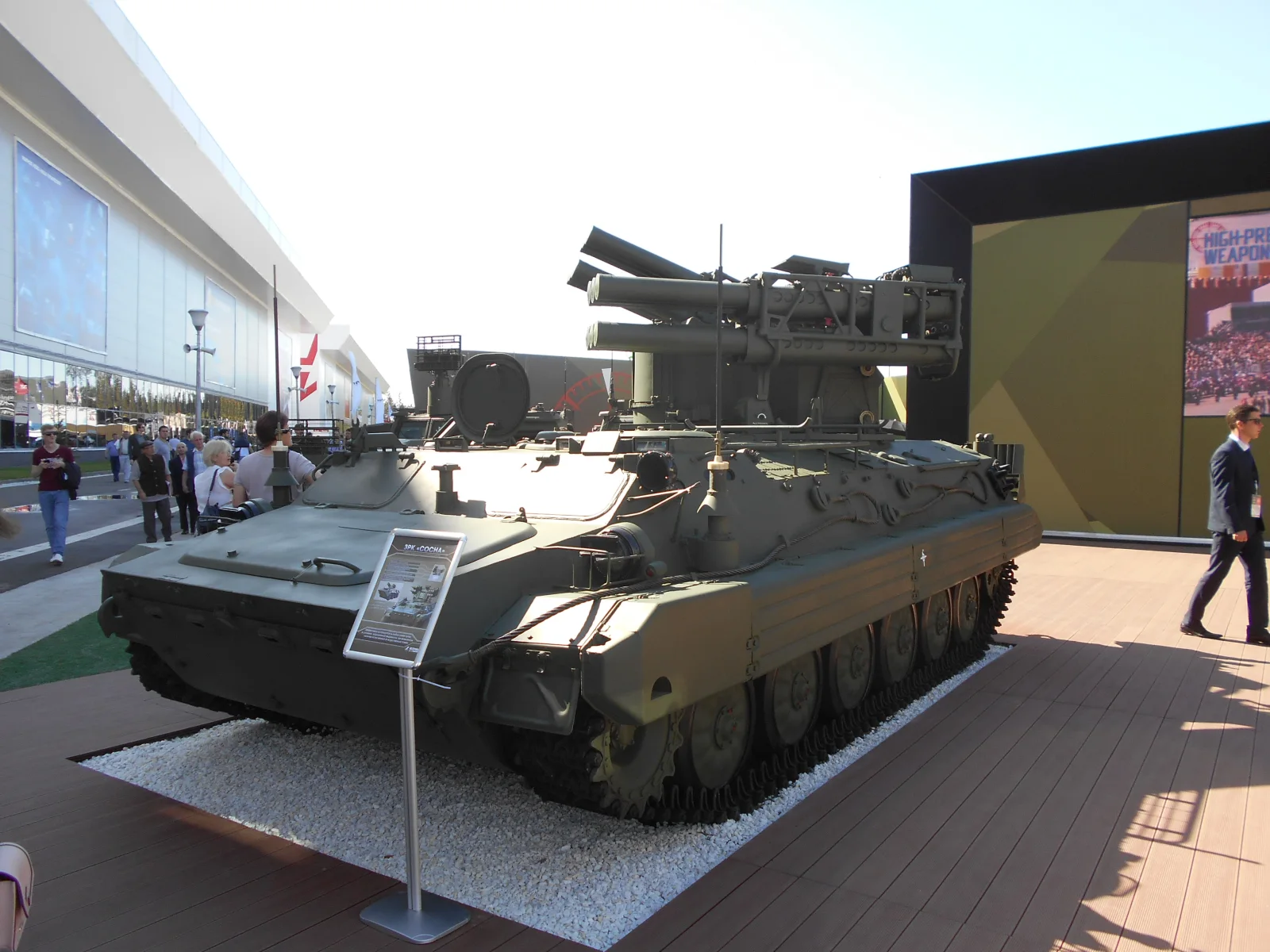
Record created from the U.S. Army Worldwide Equipment Guide, Army Recognition and Air Power Australia; added a photo of a 2S6M vehicle.
Newsletter · every two weeks
The Interceptors Brief
What changed in air defence and counter-drone, in five minutes, with the sources attached.
Confirm by email · unsubscribe in one click · Privacy