| Role |
|---|
| Primary category | Interceptor Missiles | Interceptor Missiles | Interceptor Missiles | Interceptor Missiles |
|---|
| Subcategory | Medium-range air-defense missiles | Medium-range air-defense missiles | Short-range air-defense missiles | Medium-range air-defense missiles |
|---|
| Interception mechanism | Direct impact | Blast-fragmentation, Proximity fuze | Blast-fragmentation, Proximity fuze | Blast-fragmentation, Proximity fuze |
|---|
| Target types | Crewed aircraft, Cruise missiles, One-way attack UAVs, Small UAS | Crewed aircraft, Cruise missiles, One-way attack UAVs | Crewed aircraft, Cruise missiles, One-way attack UAVs, Small UAS | Crewed aircraft, Cruise missiles, One-way attack UAVs |
|---|
| Platform | Vehicle-mounted, Containerised | Vehicle-mounted, Trailer | Vehicle-mounted, Shipborne | Vehicle-mounted, Shipborne |
|---|
| Status | In service | In service | In service | In service |
|---|
| Developer · Country | Diehl Defence · Germany | Kongsberg Defence & Aerospace, RTX (Raytheon) · Norway | MBDA UK · United Kingdom | ASELSAN, Roketsan · Türkiye |
|---|
| Propulsion | Solid rocket motor | Solid rocket motor | Solid rocket motor | Solid rocket motor |
|---|
| Reusability | Single-use | Single-use | Single-use | Single-use |
|---|
| Technical profile |
|---|
| Seeker | Imaging infrared, jamming-resistant seeker[1] | Depends on effector: AIM-120 AMRAAM and AMRAAM-ER active radar; AIM-9X Block II imaging infrared[1][2] | Active RF seeker with a GaN solid-state amplifier[3] | Imaging infrared on HİSAR-O+; active RF (radar) seeker on HİSAR-O RF[1][3][10] |
|---|
| Guidance | Target data and mission abort via in-flight uplink; IIR terminal homing for direct hit[1] | Not recorded | Inertial with mid-course updates; active radar terminal homing[3] | Inertial midcourse with data-link updates from the fire-control system; terminal homing[3][8] |
|---|
| Warhead | Not detailed for SLM; the air-to-air IRIS-T carries an 11.4 kg HE-fragmentation warhead (reference work)[1][2] | Not recorded | 10 kg high-explosive blast-fragmentation[3] | High-explosive fragmentation; warhead developed by TÜBİTAK SAGE[1][10] |
|---|
| Fuze | Not recorded | Not recorded | Laser proximity and impact[3] | Impact and proximity; RF proximity fuze used in the long-range 2023 test of the RF missile[3][10] |
|---|
| Motor / propulsion | Smokeless, insensitive solid motor; thrust-vector control for a small inner dead zone[1] | Not recorded | Solid motor shared with ASRAAM (CAMM); new Avio motor on CAMM-ER[3] | Dual-pulse solid-propellant motor (family design); vertical launch[3][10] |
|---|
| Data link | In-flight uplink for target data transmission and mission abort[1] | Not recorded | Two-way data link; on land it is provided through the iLauncher[3] | RF data link from the fire-control centre for midcourse updates[3] |
|---|
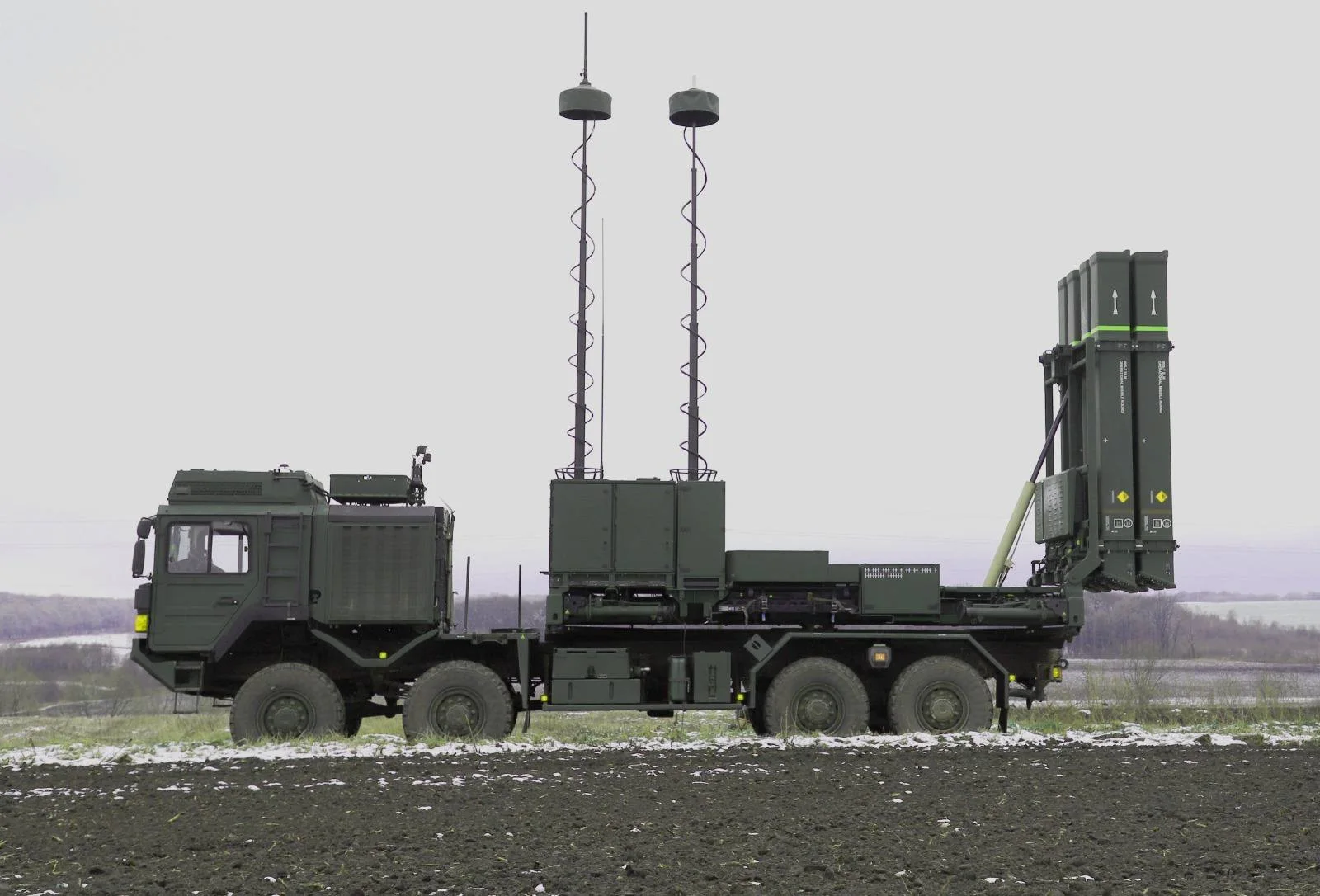
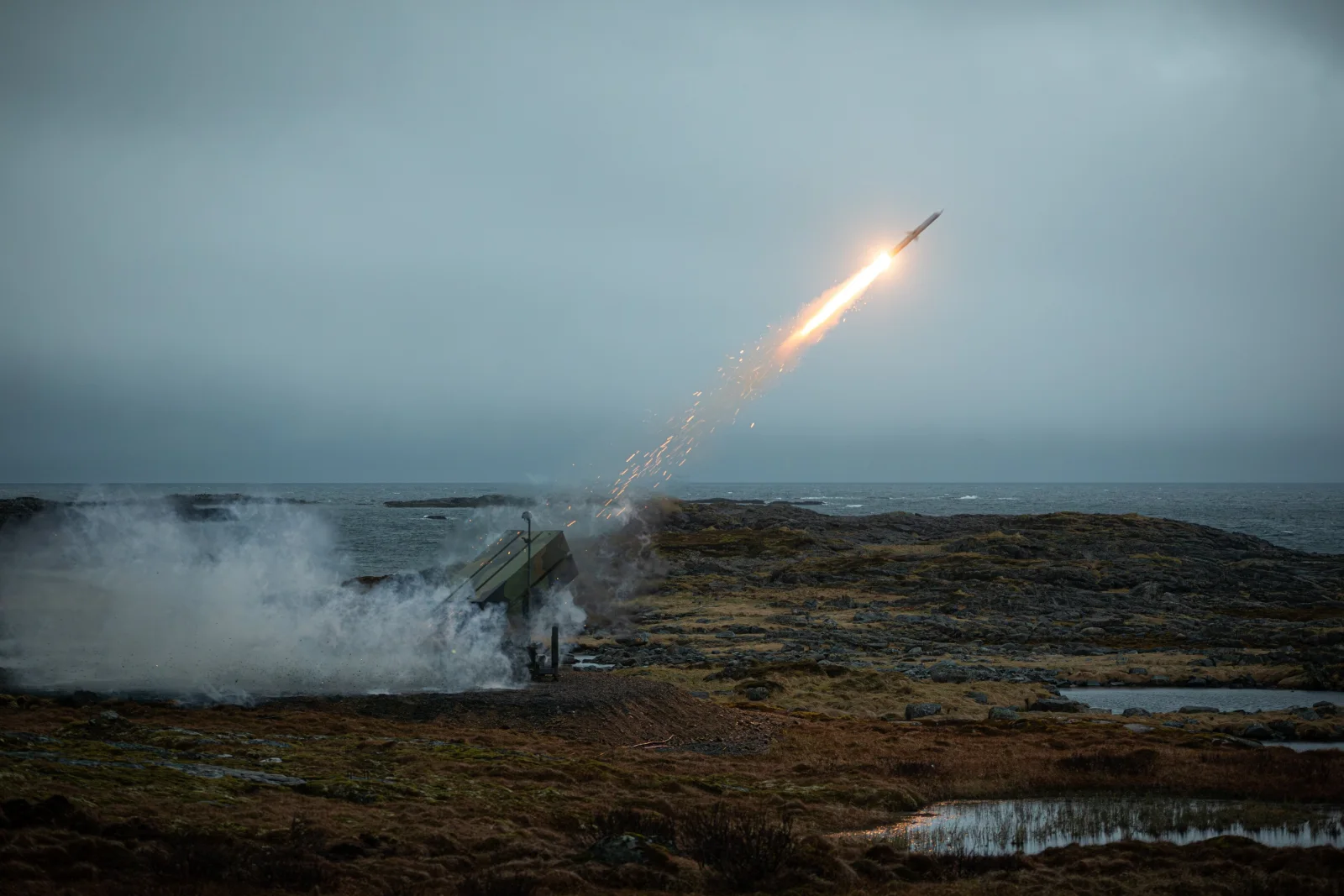
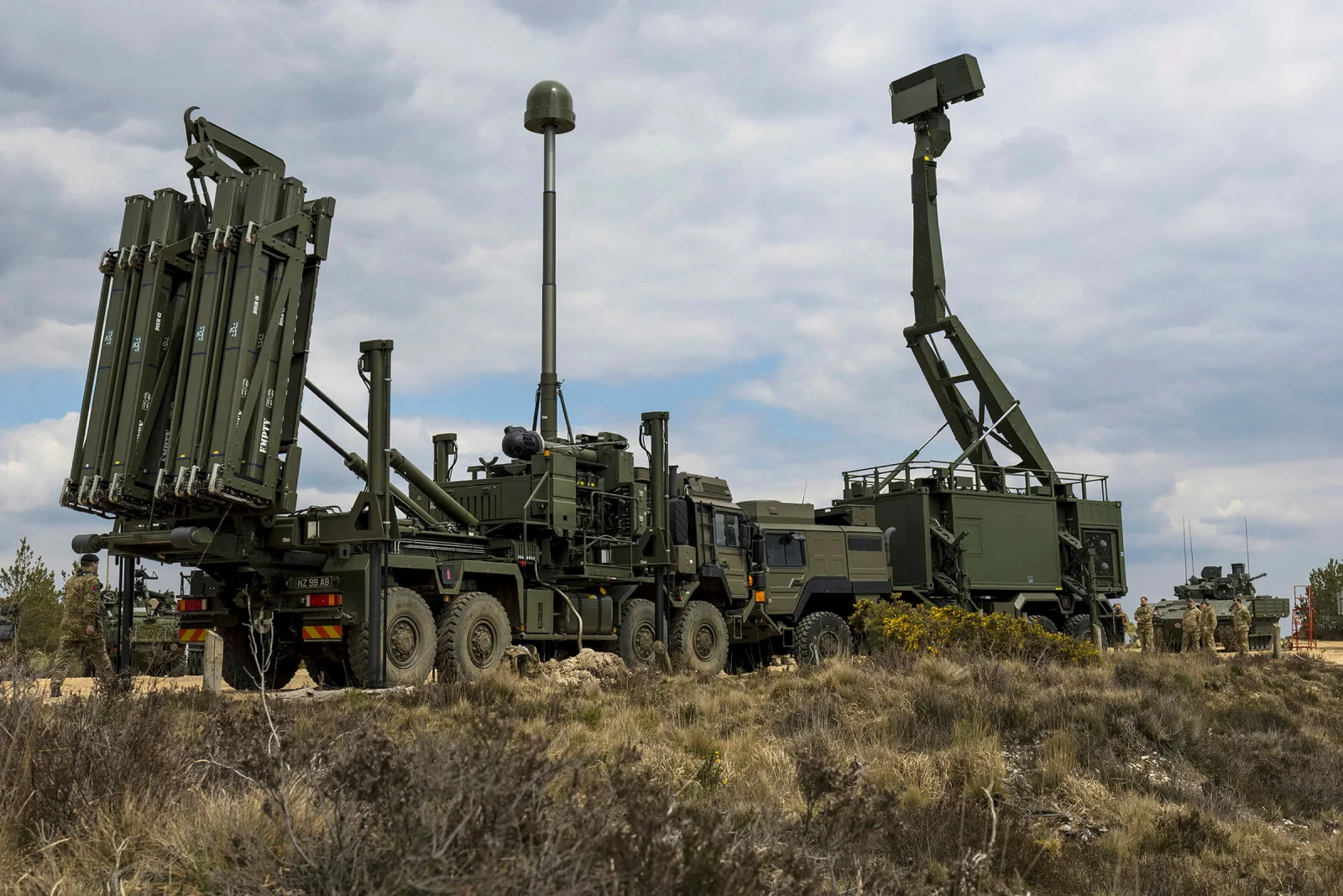
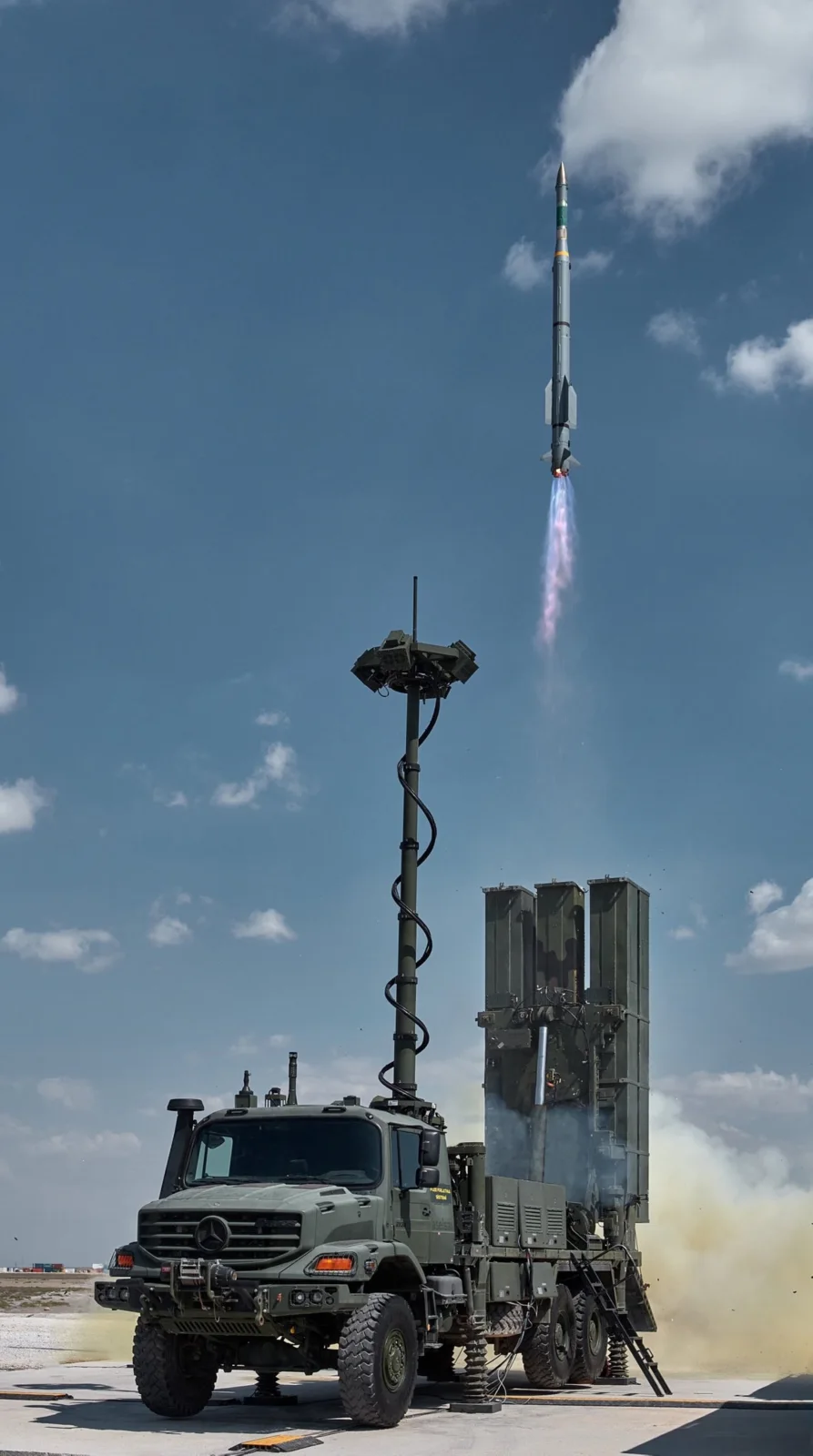
| Launcher | Eight-cell launcher on a 20-ft ISO frame (Bundeswehr: on Rheinmetall MAN HX 8×8), own power supply, ready within 10 minutes[1][3] | Six-canister launcher (towed or truck); NASAMS 3 adds the Mk 2 canister launcher and the air-liftable High Mobility Launcher[3] | Soft vertical launch by gas generator; iLauncher carries up to 8 CAMM or CAMM-ER on an 8×8 truck; naval cells and ExLS/Mk 41 options[1][3] | Mercedes-Benz Zetros 6×6 truck with vertical launch canisters[3][7] |
|---|
| Rounds per launcher | 8 per launcher; 3 launchers per German fire unit[3] | 6 per launcher; a NASAMS 2 fire unit has three launchers[3] | | 6 ready missiles per launcher; battery of 3 launchers (18 missiles), battalion of 9 (54)[3] |
|---|
| Fire control / radar | Hensoldt TRML-4D AESA radar (250 km, IFF Mode 5) and tactical operations centre with Airbus IBMS-FC software[1][3] | AN/MPQ-64F1 Sentinel 3D radar, Kongsberg Fire Distribution Centre and EO/IR sensor; radars and launchers can sit over 20 km from the FDC[1][3] | Sky Sabre: Saab Giraffe AMB C-band radar and Rafael command system; Narew: Polish radars and US IBCS[2][3][4] | ASELSAN KALKAN 3D phased-array radar, EO vehicle, fire-control centre and tactical data-link vehicle; 60+ tracks[2][3] |
|---|
| Reaction / readiness | Not recorded | Not recorded | Land Ceptor ready in under 20 minutes; MoD says Sky Sabre can control 24 missiles simultaneously[2][5] | Not recorded |
|---|
| Crew | TOC manned by two operators in the export version[3] | | Not recorded | Not recorded |
|---|
| Characteristics |
|---|
| Maximum range (km) † | 40 km† Maximum engagement range as claimed by the developerManufacturer claim[1][2] | ≈ 40 km† Range reported in secondary sourcesSecondary reference[3] | At least 25 km† Range reported in secondary sourcesSecondary reference[3] | At least 25 km† Official range band published by the manufacturerManufacturer claim[1][2] |
|---|
| Detection range (km) | Not recorded | 120 kmSecondary reference[3] | Not recorded | Not recorded |
|---|
| Maximum altitude (km) | | 21 kmSecondary reference[3] | 10 kmSecondary reference[3] | At least 15 kmManufacturer claim[1] |
|---|
| Speed (m/s) | Not recorded | Not recorded | Mach 3Secondary reference[3] | Not recorded |
|---|
| Mass (kg) | Not publicly disclosedManufacturer claim[1] | Not recorded | 99 kgManufacturer claim[1] | Not recorded |
|---|
| Length (m) | Not recorded | Not recorded | 3.2 mManufacturer claim[1] | 4.6 mManufacturer claim[1] |
|---|
| Guidance / cueing | Imaging infrared seeker; in-flight uplink for target data and mission abortManufacturer claim[1] | Missile-dependent: AMRAAM active radar; AIM-9X imaging infraredManufacturer claim[1][2] | Inertial with mid-course update; active radar terminal homingSecondary reference[3] | INS and data link midcourse; IIR or RF terminal seekerManufacturer claim[1] |
|---|
| Effect | High direct-hit capability (manufacturer); warhead not detailed in the flyerManufacturer claim[1] | Not recorded | HE blast-fragmentation; laser proximity and impact fuzeSecondary reference[3] | High-explosive fragmentationManufacturer claim[1] |
|---|
| Launch / operating platform | Truck-mounted launchers on 20-foot ISO frames, with radar and TOCManufacturer claim[1] | Canister launchers with Sentinel radar and fire distribution centreManufacturer claim[1] | Sky Sabre launcher truck; ship canisters (Sea Ceptor)Official document[2][1] | Not recorded |
|---|
| Programme |
|---|
| Operators (in service / ordered) | | 18: Norway, United States, Ukraine, Australia, Chile, Finland, Hungary, Indonesia, Lithuania, Netherlands, Oman, Qatar +6 more[1][3][4][5][6][8] | 8: United Kingdom, Poland, New Zealand, Chile, Brazil, Italy, Saudi Arabia, Sweden[3][4][5] | |
|---|
| Platforms and integration | Hensoldt TRML-4D radar (in service), Airbus IBMS-FC tactical operations centre (in service), Rheinmetall MAN HX 8×8 launcher trucks (in service), IRIS-T SLS / SLS Mk III (short-range sibling) (in service)[1][2][3] | AN/MPQ-64F1 Sentinel radar (in service), Kongsberg Fire Distribution Centre (FDC) (in service), Link 16, Link 11 and JREAP (in service), Patriot interoperability (in service), High Mobility Launcher (HML) (in service), Mobile GBAD with IRIS-T SLS launchers (in service)[1][3][8] | Sky Sabre (iLauncher, Giraffe AMB, Rafael C2) (in service), Sea Ceptor on Type 23 frigates (in service), Type 26 and Type 31 frigates (ordered), Narew (CAMM-ER, iLauncher on Jelcz, IBCS) (ordered), Pilica+ (CAMM with PSR-A Pilica) (in service), Anzac-class frigates (20-cell) (in service), Tamandaré-class frigates (12-cell) (ordered), Visby-class corvettes (ordered) +1 more[3][4][5] | Mercedes-Benz Zetros 6×6 launcher truck (in service), ASELSAN KALKAN 3D search radar (in service), Steel Dome (delivered as HİSAR O 100) (in service), HİSAR-D RF from MİDLAS on TCG İstanbul (tested), Trisula-O (Indonesian variant) (ordered)[3][6] |
|---|
| Public contracts | | | 5 recorded. Latest: 2025-08-22 · United Kingdom (MoD) · 6 launchers · £118 million[3][4][5][7][8][9] | Not recorded |
|---|
| Production / deliveries | to December 2023: more than 5,000 IRIS-T missiles cumulative, target: 2,000 missiles a year planned rate, end of 2025: 800–1,000 missiles a year planned rate, 2028: 16 systems a year planned rate[2][5][8] | Not recorded | 2022–2026: monthly CAMM-family output to triple planned rate[3] | 2025-08-27: 3 systems (21 vehicles) delivered[3][6] |
|---|
| Backlog | Not recorded | NOK 174.2 billion (as of Q3 2026)[7] | Not recorded | Not recorded |
|---|
| Latest development | 2026-02-13: First German fire unit[2] | 2025-02: Norwegian figures for Ukraine[3] | 2024-03-09: First combat use[3] | 2025-08-27: Steel Dome delivery[3][6] |
|---|