| Role |
|---|
| Primary category | Interceptor Missiles | Interceptor Missiles | Interceptor Missiles | Interceptor Missiles |
|---|
| Subcategory | Long-range air-defense missiles | Ballistic-missile interceptors · Endo-atmospheric | Medium-range air-defense missiles | Very-short-range air-defense missiles |
|---|
| Interception mechanism | Blast-fragmentation | Hit-to-kill | Blast-fragmentation, Proximity fuze | Blast-fragmentation, Proximity fuze |
|---|
| Target types | Crewed aircraft, Cruise missiles, Ballistic missiles | Ballistic missiles, Crewed aircraft | Crewed aircraft, Cruise missiles, Ballistic missiles, Small UAS | Crewed aircraft, Small UAS |
|---|
| Platform | Trailer | Vehicle-mounted | Vehicle-mounted, Shipborne | Vehicle-mounted |
|---|
| Status | In service | In production | In service | In service |
|---|
| Developer · Country | National Chung-Shan Institute of Science and Technology (NCSIST) · Taiwan | Agency for Defense Development, LIG Defense & Aerospace (formerly LIG Nex1), Hanwha Aerospace, Hanwha Systems · South Korea | Israel Aerospace Industries, Defence Research and Development Organisation (DRDO) · Israel | National Chung-Shan Institute of Science and Technology (NCSIST) · Taiwan |
|---|
| Propulsion | Solid rocket motor | Solid rocket motor | Solid rocket motor | Solid rocket motor |
|---|
| Reusability | Single-use | Single-use | Single-use | Single-use |
|---|
| Technical profile |
|---|
| Seeker | Microwave (active radar) terminal seeker; Ku-band per reference work[1][5] | Imaging-infrared seeker[1] | Active radar seeker on each interceptor, switched on for the terminal phase[3][4] | All-aspect infrared seeker with IRCCM[1] |
|---|
| Guidance | Mid-course integral navigation (inertial plus radar uplink/downlink); terminal seeker homing[1] | Divert and attitude control system (10 valves) for end-game manoeuvring before direct impact[1][3] | Mid-course updates from the weapon control system over a two-way data link; active radar terminal homing[3] | Fire-and-forget infrared homing, or slaved to the radar[1] |
|---|
| Warhead | Directional (directed-fragmentation) warhead[1] | | Blast-fragmentation, 60 kg (Barak 8)[3] | High-explosive fragmentation[1] |
|---|
| Fuze | Not recorded | Not recorded | | Laser proximity and contact[1] |
|---|
| Motor / propulsion | Single-stage solid propellant; vertical launch; aerodynamic control[1] | Dual-pulse solid rocket motor; three stages per reference work[1][3][6] | Dual-pulse solid rocket motor with thrust-vector control; Barak ER adds a booster stage[3][4] | |
|---|
| Data link | Two-way: phased-array radar uplinks target and missile tracks and receives missile downlink[1] | Not recorded | Two-way data link between missile and weapon control system[3] | Not recorded |
|---|
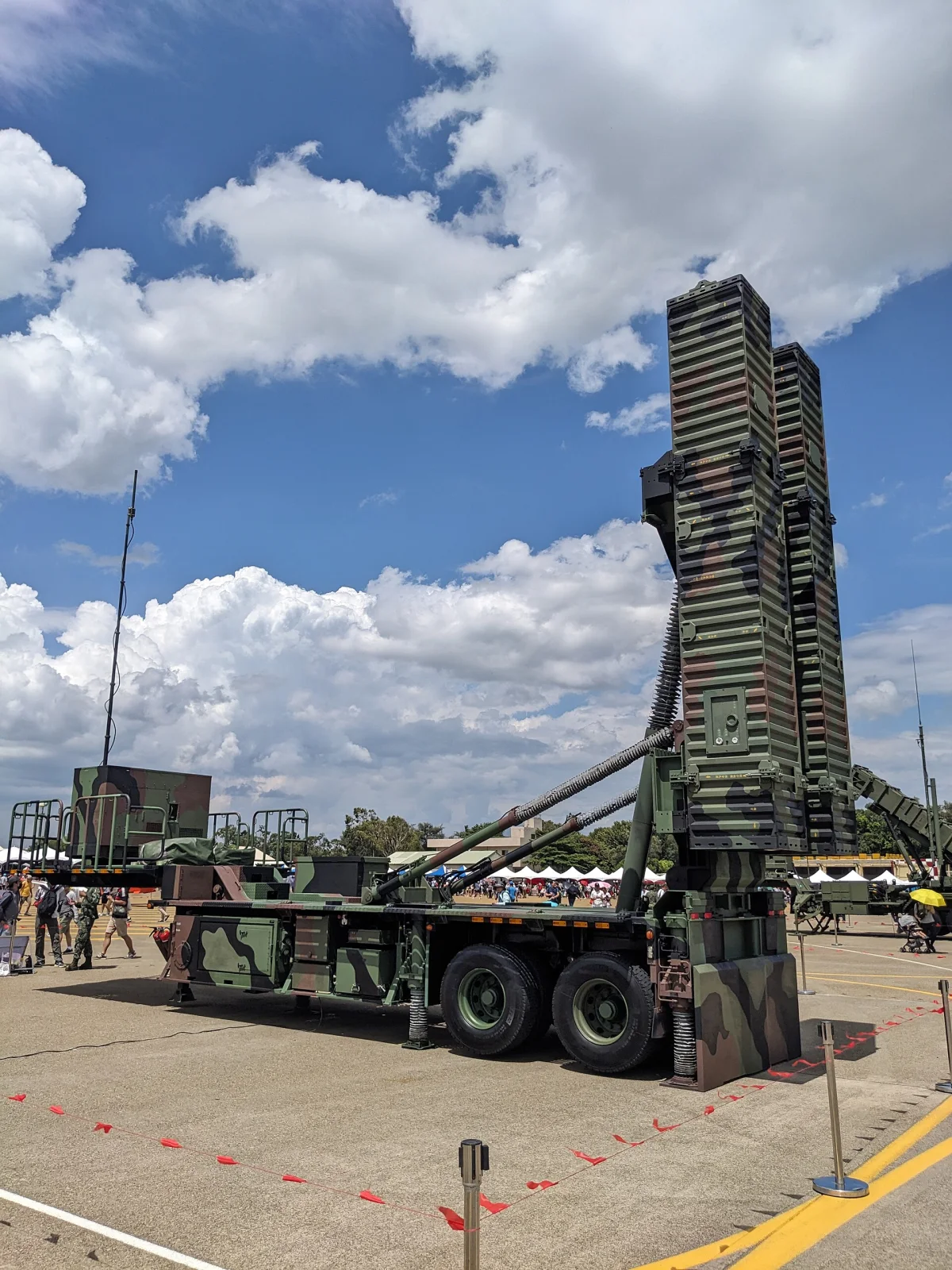
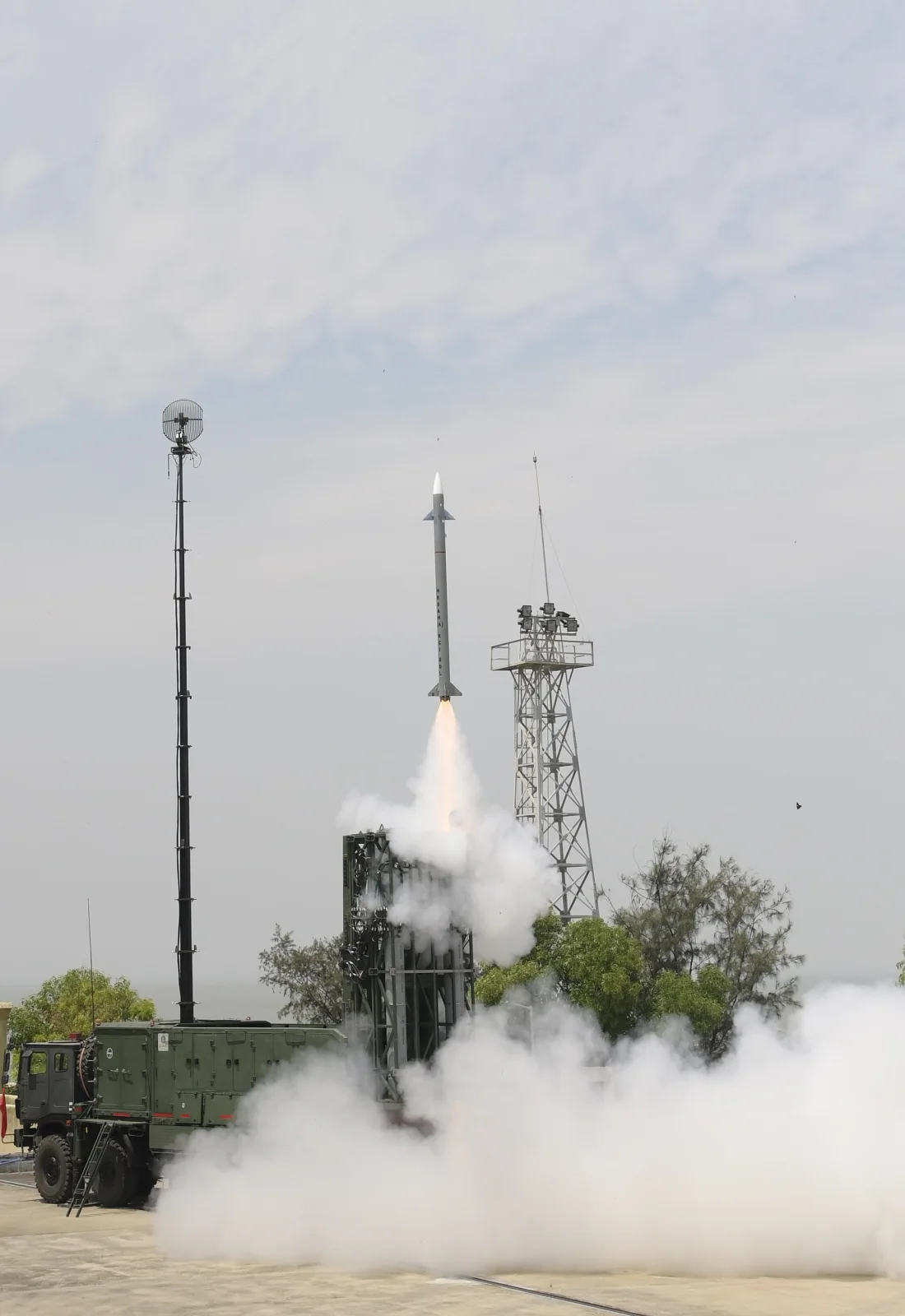
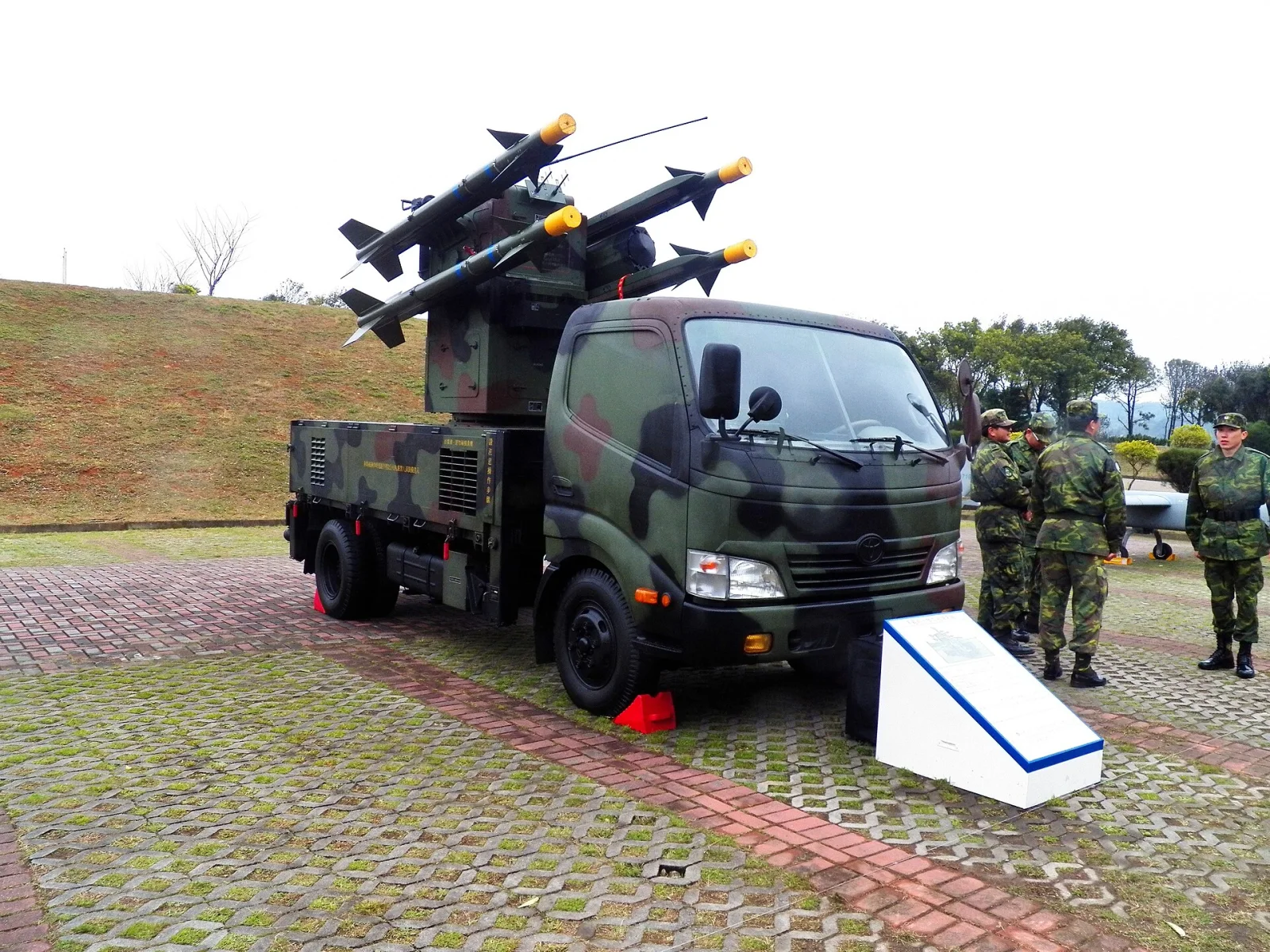
| Launcher | Self-contained mobile launcher, remotely operated by the ECS; canister 5.5 × 0.8 × 0.84 m[1][7] | Truck-mounted launchers; four per battery (reference work)[5][6] | Vertical launch from canisters: 8-cell naval VLS modules and 8-round mobile land launchers[3] | Trainable turret with four TC-1L rails on a light commercial truck chassis[1][2] |
|---|
| Rounds per launcher | Four canisters per launcher, TK-III or TK-II missiles[1] | Six missiles per launcher, anti-ballistic and anti-aircraft rounds mixed by battery (reference work)[6] | 8 per launcher; an Indian MRSAM firing unit has 3 launchers[3] | 4 missiles; reloading takes time, according to Taiwanese press[1][2] |
|---|
| Fire control / radar | Phased-array radar (anti-aircraft, anti-TBM or mixed modes, IFF, ECCM), engagement control station, power plant, comms relay[1] | S-band AESA multifunction radar (Hanwha Systems), engagement control post and C2 centre[1][5][6] | MRSAM: multi-function radar, command post and mobile launchers; Indian Navy ships: EL/M-2248 MF-STAR[2][3][6] | Integrated target acquisition: radar, FLIR, synchronised visual aimer and IFF[1] |
|---|
| Crew | Not recorded | Not recorded | Not recorded | |
|---|
| Characteristics |
|---|
| Maximum range (km) † | Up to 200 km† Range reported in secondary sourcesSecondary reference[2] | ≈ 150 km† Range reported in secondary sourcesSecondary reference[6] | Up to 150 km† Maximum engagement range as claimed by the developerManufacturer claim[1] | ≈ 9 km† Range reported in secondary sourcesSecondary reference[3][2] |
|---|
| Maximum altitude (km) | Up to 45 kmSecondary reference[3] | ≈ 50–60 kmSecondary reference[4] | Not recorded | Not recorded |
|---|
| Speed (m/s) | Up to 2,380 m/sSecondary reference[5] | Up to 3,060 m/sSecondary reference[6] | Not recorded | Not recorded |
|---|
| Mass (kg) | 870 kgSecondary reference[5] | Not recorded | 275 kgSecondary reference[3] | Not recorded |
|---|
| Length (m) | 5.5 mSecondary reference[5] | ≈ 7 mSecondary reference[6] | 4.5 mSecondary reference[3] | Not recorded |
|---|
| Ready rounds / magazine | Four canisters per launcherManufacturer claim[1] | Not recorded | Not recorded | Four TC-1L missilesManufacturer claim[1] |
|---|
| Guidance / cueing | Inertial plus radar uplink mid-course; active microwave terminal seekerManufacturer claim[1] | Imaging-infrared seeker; divert and attitude control systemOfficial document[1][3] | Two-way data link mid-course; active radar seekerSecondary reference[3] | Infrared seeker, fire-and-forget; radar, FLIR and visual cueingManufacturer claim[1] |
|---|
| Effect | Directional fragmentation warheadManufacturer claim[1] | Hit-to-killOfficial document[1] | Not recorded | HE fragmentation warhead; laser proximity and contact fuzeManufacturer claim[1] |
|---|
| Launch / operating platform | Mobile vertical launcher trailerManufacturer claim[1] | Mobile launchers with a multi-function radar and engagement control postSecondary reference[6][1] | Mobile land launchers and shipborne vertical launch cellsOfficial document[2][1] | Truck or HumveeManufacturer claim[1][3] |
|---|
| Programme |
|---|
| Operators (in service / ordered) | | | | |
|---|
| Platforms and integration | Patriot (joint air-defence network in Taiwan) (in service), TK-I and TK-II launchers and missiles under the same ECS (in service), Ship-based TK-3 variant (tested), TK-4 (Strong Bow I) extended-range missile, larger 7.64 m canister (in development)[1][3][5][7] | L-SAM multifunction radar (Hanwha Systems) (ordered), Truck-mounted launchers (ordered), Korean Air and Missile Defence, layered above Cheongung II and PAC-3 (in development), LIG Nex1 anti-aircraft interceptor for the same battery (tested)[1][5][6] | Kolkata- and Visakhapatnam-class destroyers (LR-SAM) (in service), Nilgiri-class frigates and INS Vikrant (in service), Sa'ar 5-class corvettes (in service), MRSAM mobile launchers and radar on Tata 8×8 trucks (in service), EL/M-2248 MF-STAR naval radar (in service), Elta MMR radars (Greek Achilles Shield) (ordered)[2][3][9] | Light commercial truck chassis (in service), Humvee-based air-defence system (1994–1998 development) (tested)[1][2][3] |
|---|
| Public contracts | Not recorded | 4 recorded. Latest: 2025-11-27 · South Korea (DAPA) · 705.4 billion won (about US$480 million)[5][7][8][9][10] | 4 recorded. Latest: 2026-08-31 · Greece · approximately €3 billion for the whole package[4][6][7][9][10][11] | Not recorded |
|---|
| Production / deliveries | 2023–2026: 12 new TK-3 sites planned rate, 2021: 23 missiles produced, 2014: initial run of 12 batteries ordered[4][5][6] | 2025–2030: Interceptors and launchers under the 705.4 billion won contract ordered[5] | BDL Hyderabad facility: 100 missiles a year planned rate[3] | 2026: 17–20 systems in service cumulative[2] |
|---|
| Latest development | 2026: TK-4 (Strong Bow I) production planned[7] | 2025-12: Mass production approved[5] | 2025-05: Reported intercept during India–Pakistan fighting[3] | 2026-10: Life extension budgeted[2] |
|---|