| Role |
|---|
| Primary category | Interceptor Missiles | Interceptor Missiles | Interceptor Missiles | Interceptor Missiles |
|---|
| Subcategory | Very-short-range air-defense missiles | Very-short-range air-defense missiles | Short-range air-defense missiles | Very-short-range air-defense missiles |
|---|
| Interception mechanism | Blast-fragmentation, Direct impact | Blast-fragmentation, Direct impact | Blast-fragmentation | Blast-fragmentation, Proximity fuze |
|---|
| Target types | Crewed aircraft, Small UAS, One-way attack UAVs, Cruise missiles | Crewed aircraft, Small UAS, One-way attack UAVs, Cruise missiles | Crewed aircraft, Cruise missiles, Small UAS, One-way attack UAVs | Crewed aircraft, Small UAS, One-way attack UAVs |
|---|
| Platform | Vehicle-mounted | Man-portable, Vehicle-mounted | Vehicle-mounted | Man-portable, Vehicle-mounted, Airborne |
|---|
| Status | In service | In service | In production | In service |
|---|
| Developer · Country | KBM (Machine-Building Design Bureau, Kolomna) · Russia | KBM (Machine-Building Design Bureau, Kolomna) · Russia | Shvabe · Russia | RTX (Raytheon) · United States |
|---|
| Propulsion | Solid rocket motor | Solid rocket motor | Solid rocket motor | Solid rocket motor |
|---|
| Reusability | Single-use | Single-use | Single-use | Single-use |
|---|
| Technical profile |
|---|
| Seeker | That of the loaded MANPADS missile: Igla/Igla-S infrared or Verba three-band optical[1][2][3] | Passive three-band optical seeker: ultraviolet, near-infrared and mid-infrared[1][3][5] | Not recorded | Passive infrared; POST and RMP versions use a dual IR/UV detector, cooled by argon from the battery coolant unit[2] |
|---|
| Guidance | Not recorded | Passive homing after launch; an external IFF interrogator can be coupled[1][5] | Laser beam-riding after booster separation; GlobalSecurity adds radio-command guidance in the boost phase[3][4][5] | Fire-and-forget; proportional navigation, then a mode that steers toward the airframe rather than the exhaust plume[2] |
|---|
| Warhead | Not recorded | | Two warheads, 7 kg in total: rod (proximity) and armour-piercing fragmentation (impact)[4][5] | HE-fragmentation with about 1.02 kg of HTA-3 explosive (the reference work's infobox gives 3 kg for the warhead)[2] |
|---|
| Fuze | Not recorded | Not recorded | Laser proximity-and-impact fuze[4][5] | Impact fuze with self-destruct 17 s after launch; FIM-92J adds a proximity-fuzed warhead section for unmanned targets[2][4] |
|---|
| Motor / propulsion | Not recorded | Solid-propellant rocket motor[5][6] | Two-stage missile; the booster separates, cutting calibre from 130 mm to 72 mm[4][5] | Small ejection motor, then a two-stage solid-propellant flight motor; FIM-92J has a new flight motor[2] |
|---|
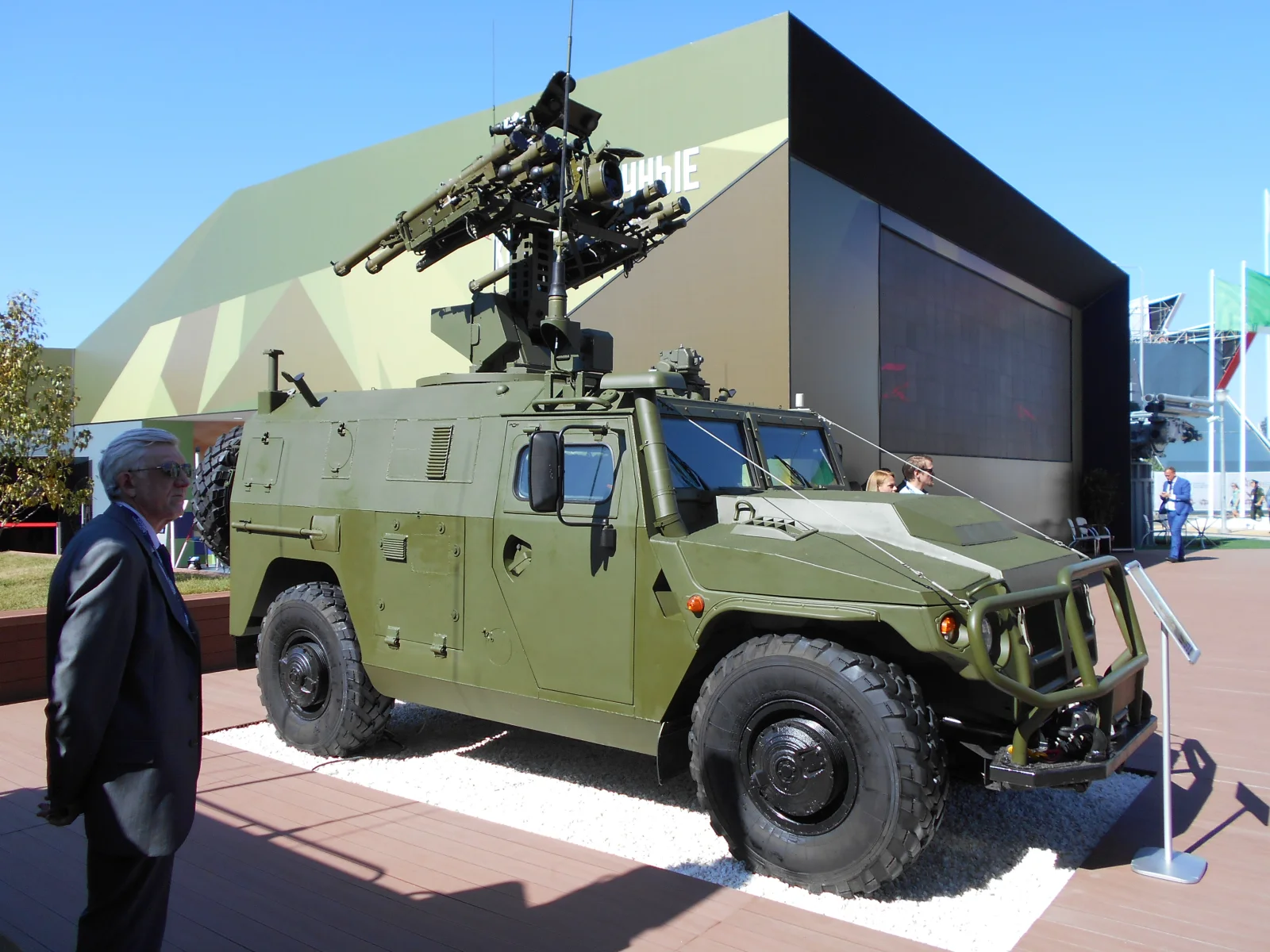
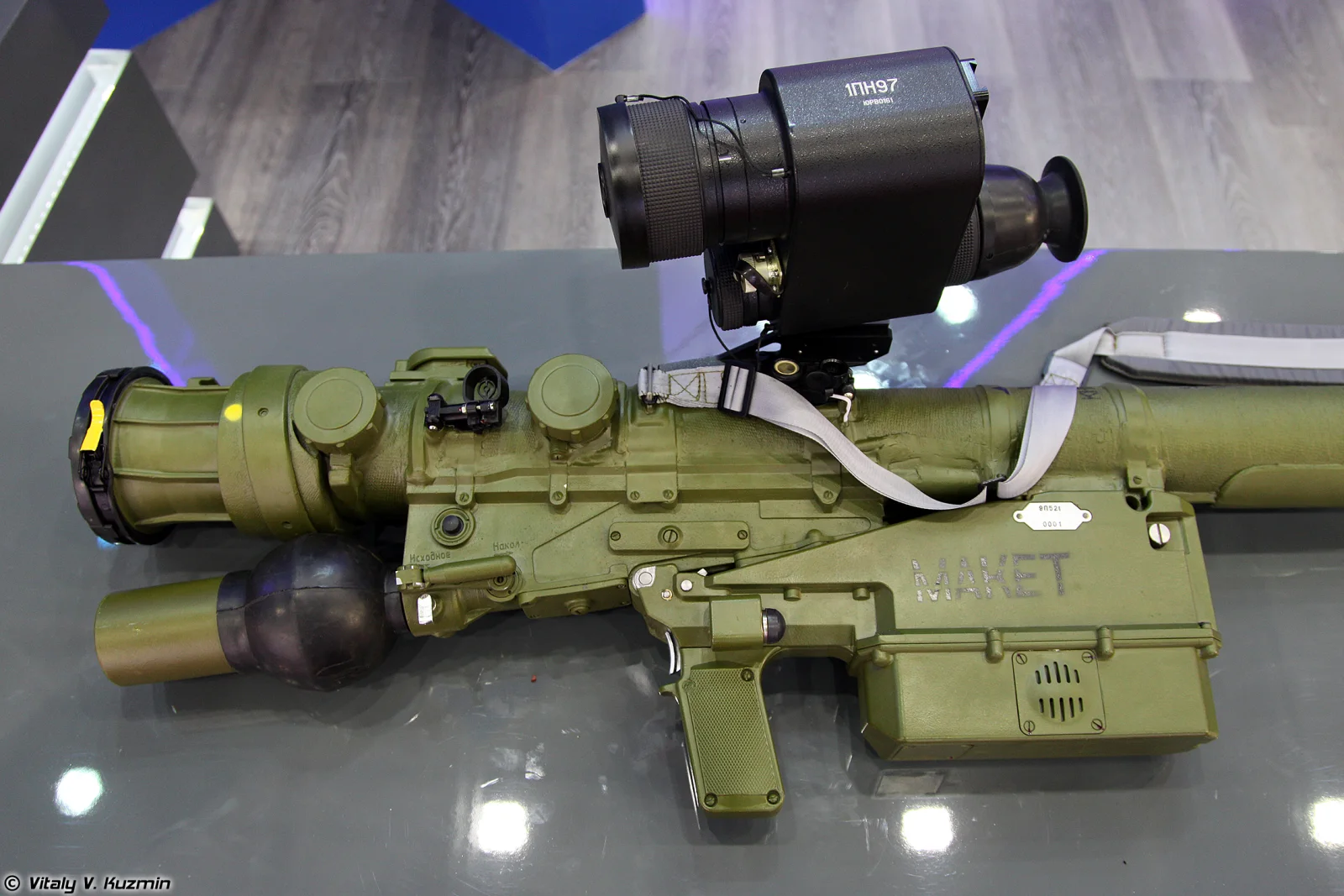
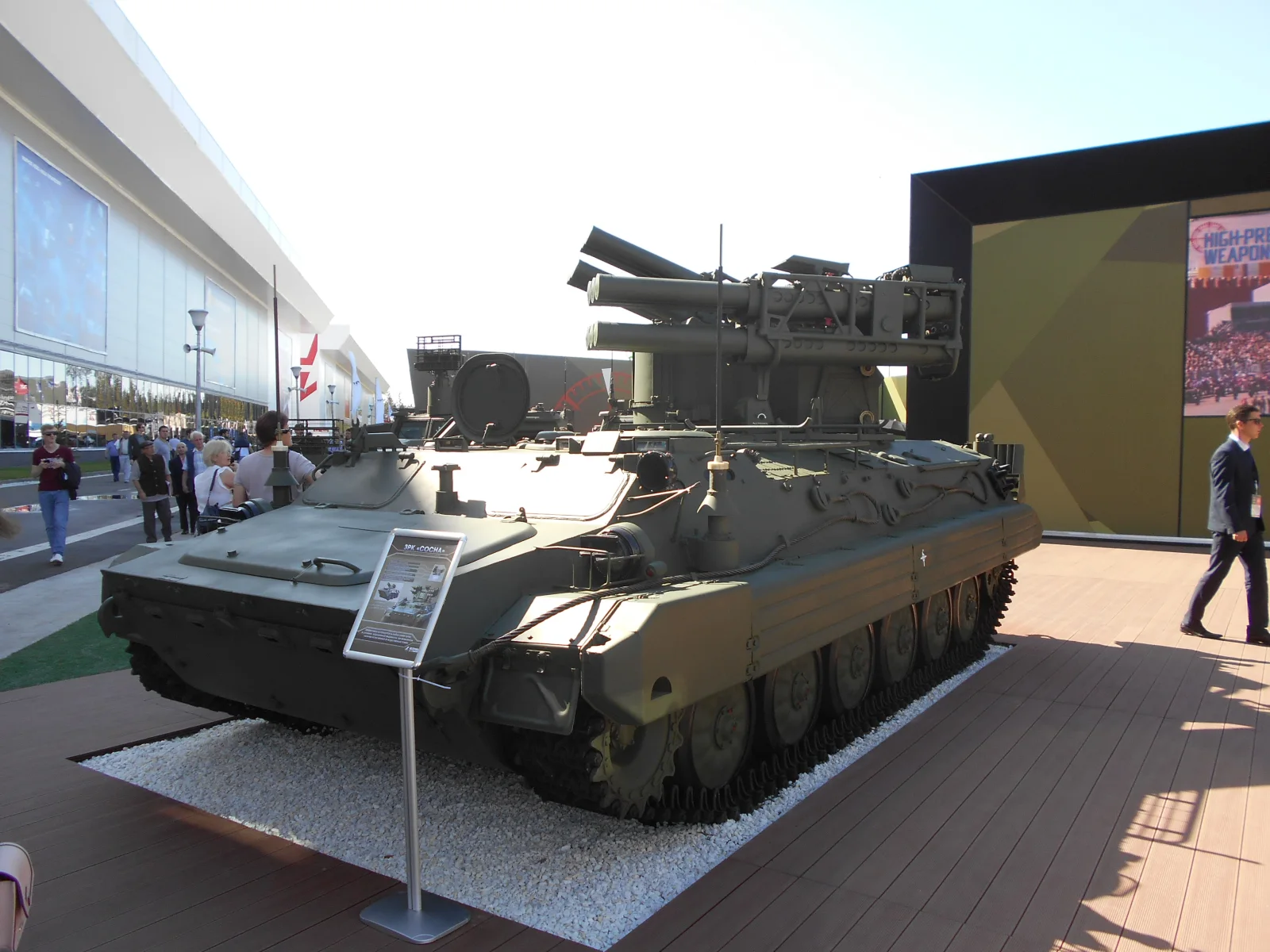
| Launcher | Roof-mounted, remotely aimed launcher for four launch containers on a Tigr / Tigr-M armoured 4×4[1][2] | 9P521 shoulder launcher with the 9M336 missile in its tube; the containerised missile can also be fitted to vehicle and naval mounts[5][6] | Turret with two packs of six transport-launch containers; MT-LB base chassis, also shown on BMP-3 and BTR-82A[4][5] | Shoulder gripstock; Avenger and M6 Linebacker vehicles; Air-to-Air Stinger on AH-64, Tiger and T129 helicopters[2] |
|---|
| Rounds per launcher | 4 ready plus 4 stowed (8 missiles, in two sections)[1][2] | Not recorded | 12 missiles; reload 10–12 minutes[4][5] | Not recorded |
|---|
| Fire control / radar | Separate reconnaissance and control vehicle with 40 km air search, directing up to six combat vehicles; combat vehicles can also fight autonomously[1][2] | Barnaul-T control link: 1L122 compact surveillance radar, 1L229V IFF interrogator, 9S933 portable fire-control modules[6] | Optoelectronic module: TV camera, two thermal channels, laser rangefinder and missile control channel; a small radar can be added[4][5] | Not recorded |
|---|
| Reaction / readiness | Not recorded | Not recorded | 5–8 s from target detection (developer data cited by reference work)[5] | Not recorded |
|---|
| Crew | 4: driver, squad leader and two gunners[1] | Not recorded | | Not recorded |
|---|
| Characteristics |
|---|
| Maximum range (km) † | Not recorded | Up to 6 km† Maximum engagement range as claimed by the developerManufacturer claim[1] | Up to 10 km† Maximum engagement range as claimed by the developerManufacturer claim[1] | Up to 4.8 km† Range reported in secondary sourcesSecondary reference[2][3] |
|---|
| Detection range (km) | Up to 40 kmManufacturer claim[1] | Not recorded | Not recorded | Not recorded |
|---|
| Maximum altitude (km) | Not recorded | Up to 3.5 kmManufacturer claim[1][4] | Up to 5 kmManufacturer claim[1] | Up to 3.8 kmSecondary reference[2][3] |
|---|
| Speed (m/s) | Not recorded | Up to 500 m/sSecondary reference[5] | Up to 900 m/sSecondary reference[5][4] | ≈ 750 m/sSecondary reference[2][4] |
|---|
| Mass (kg) | Not recorded | 17.25 kgSecondary reference[3] | 30 kgSecondary reference[5] | 10.1 kgSecondary reference[2] |
|---|
| Length (m) | Not recorded | Not recorded | Not recorded | 1.52 mSecondary reference[2] |
|---|
| Ready rounds / magazine | 4 ready launch containers + 4 stowed missilesManufacturer claim[1] | Not recorded | 12 Sosna-R missilesManufacturer claim[1] | Not recorded |
|---|
| Guidance / cueing | Infrared-homing Igla-S or Verba missilesManufacturer claim[1] | Passive three-spectral (UV, near-IR, mid-IR) homingManufacturer claim[1][3] | Optoelectronic fire control; radio-command then laser beam-riding (reference work)Secondary reference[1][3] | Passive infrared homing, fire-and-forgetSecondary reference[2] |
|---|
| Effect | Not recorded | Not recorded | Not recorded | HE-fragmentation, impact fuze; proximity fuze on FIM-92J (reported)Secondary reference[2][4] |
|---|
| Launch / operating platform | Tigr / Tigr-M armoured 4×4Secondary reference[1][2] | Not recorded | MT-LB tracked chassis; wheeled variants displayedSecondary reference[1] | Shoulder launcher, Avenger, IM-SHORAD, helicoptersSecondary reference[2] |
|---|
| Programme |
|---|
| Operators (in service / ordered) | | 3: Russia, Armenia, Iran[5][6] | | 10: United States, Germany, Italy, Netherlands, Türkiye, Ukraine, United Kingdom, Japan, South Korea, Taiwan[2][6][7] |
|---|
| Platforms and integration | Tigr / Tigr-M armoured 4×4 (in service), 9K333 Verba missiles (in service), Igla and Igla-S missiles (in service), Reconnaissance and control vehicle (in service), Rosoboronexport integrated counter-UAV package (proposed)[1][2][4] | Gibka-S MANPADS combat vehicle (Tigr) (in service), Barnaul-T tactical air defence control system (in service), 1L122 compact surveillance radar (in service), Zarnitsa thermal sight (in service), Rosoboronexport integrated counter-UAV package (proposed)[5][6][7][8][9] | MT-LB tracked chassis (in service), BMP-3 chassis (tested), BTR-82A wheeled chassis (tested), Palma naval close-in system (8 Sosna-R missiles, two AO-18KDE guns) (in service)[1][4][5] | AN/TWQ-1 Avenger (in service), IM-SHORAD (Stryker) (in service), Multi-Mission Launcher (tested), AH-64 Apache (Air-to-Air Stinger) (in service), Eurocopter Tiger (in service), T129 ATAK (in service), MQ-1 Predator (tested)[2] |
|---|
| Public contracts | Not recorded | Not recorded | Not recorded | |
|---|
| Production / deliveries | Not recorded | to November 2017: 801 systems cumulative, 2014: 27-unit brigade set delivered[5][6] | Not recorded | European common production programme: 4,800+ (Türkiye) delivered, 2026 onward: Double current global capacity planned rate, 2025: 60 missiles a month planned rate[2][6] |
|---|
| Latest development | 2023-12: Photographed in Ukraine[2] | 2026-06: Issued with Zarnitsa thermal sight[5] | 2021-08: Wheeled version shown[5] | 2026-07-07: Plan to double Stinger production[6] |
|---|