| Role |
|---|
| Primary category | Interceptor Missiles | Interceptor Missiles | Interceptor Missiles | Interceptor Missiles |
|---|
| Subcategory | Long-range air-defense missiles | Medium-range air-defense missiles | Medium-range air-defense missiles | Medium-range air-defense missiles |
|---|
| Interception mechanism | Blast-fragmentation | Blast-fragmentation | Blast-fragmentation | Blast-fragmentation |
|---|
| Target types | Crewed aircraft, Cruise missiles, Ballistic missiles, One-way attack UAVs | Crewed aircraft, Cruise missiles, One-way attack UAVs | Crewed aircraft, Cruise missiles, Ballistic missiles | Crewed aircraft |
|---|
| Platform | Vehicle-mounted | Vehicle-mounted | Vehicle-mounted | Vehicle-mounted |
|---|
| Status | In service | In service | In service | In service |
|---|
| Developer · Country | Iran Ministry of Defence and Armed Forces Logistics · Iran | Iran Ministry of Defence and Armed Forces Logistics · Iran | Almaz-Antey · Russia | IRGC Aerospace Force · Iran |
|---|
| Propulsion | Solid rocket motor | Solid rocket motor | Solid rocket motor | Solid rocket motor |
|---|
| Reusability | Single-use | Single-use | Single-use | Single-use |
|---|
| Technical profile |
|---|
| Seeker | Sayyad-4: semi-active radar homing; Sayyad-4B: active radar seeker (Army Recognition). Reference work: semi-active or active terminal homing[4][6] | Sayyad-3: active radar terminal homing (Army Recognition)[6] | 9M96-family missiles: active radar homing; short-range 9M100: infrared homing[3] | Not recorded |
|---|
| Guidance | Inertial mid-course with data-link updates[4][6] | Inertial mid-course (Army Recognition)[6] | Not recorded | Not recorded |
|---|
| Warhead | Fragmentation, 180 kg (reference work)[4][6] | High-explosive fragmentation[6] | 24 kg on the 9M96E and 9M96E2; 14.5 kg on the 9M100[3] | Not recorded |
|---|
| Fuze | Proximity and direct-impact[4][6] | Not recorded | Not recorded | Not recorded |
|---|
| Motor / propulsion | Composite solid propellant, hot vertical launch; Sayyad-4B described as two-stage (Army Recognition) or hybrid solid fuel (reference work)[4][6] | Not recorded | Not recorded | Not recorded |
|---|
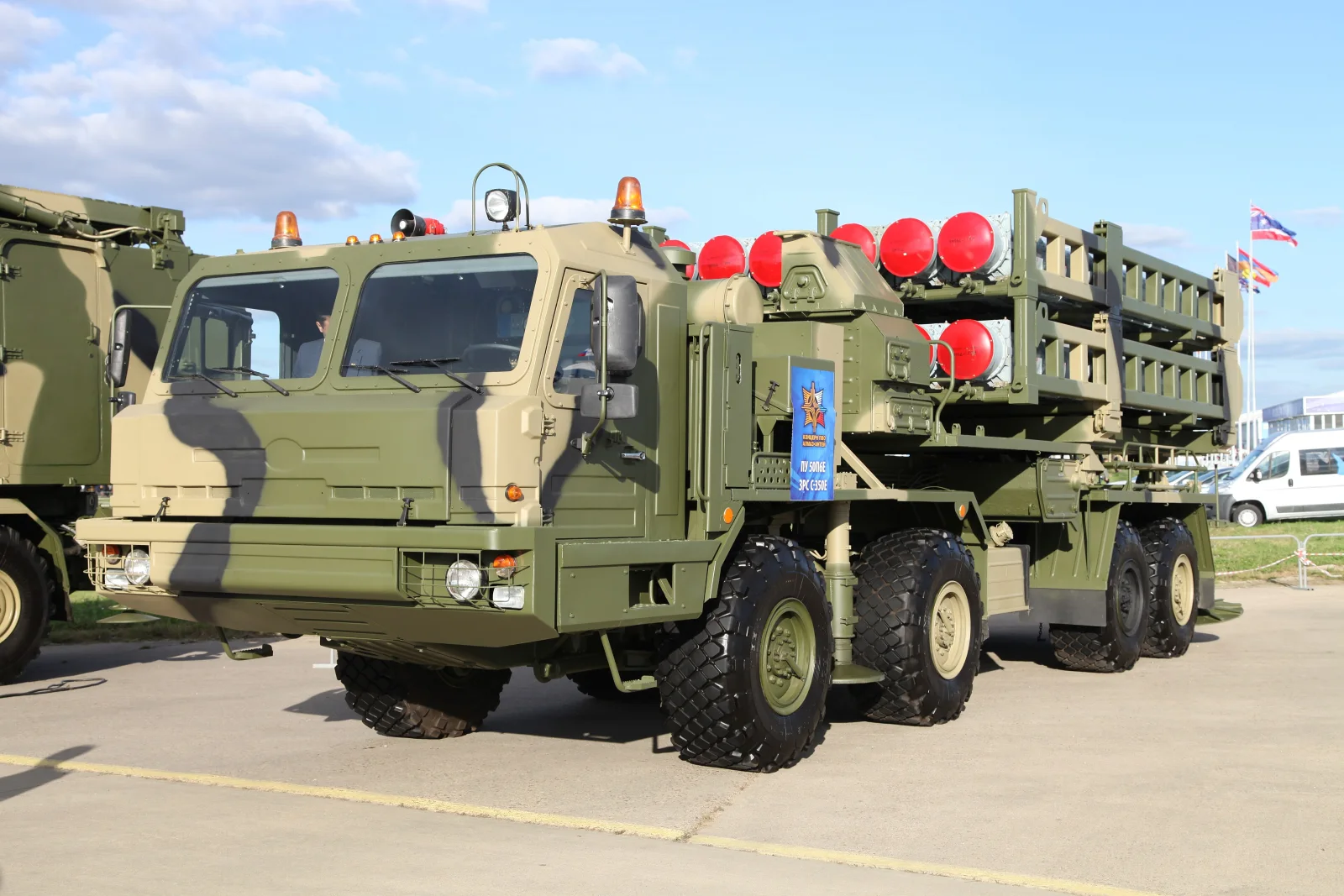
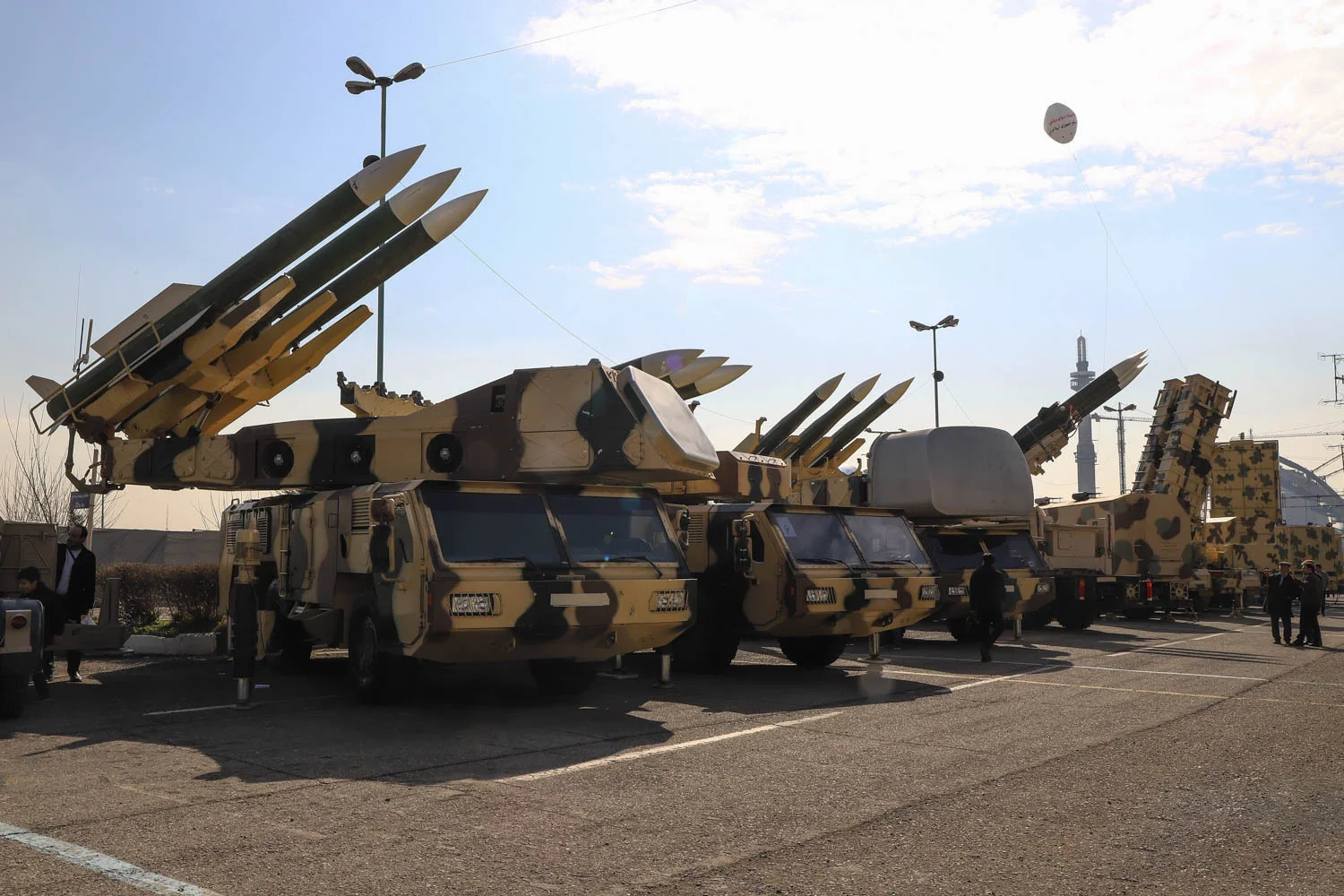
| Launcher | Rectangular vertical-launch canisters on a Zoljanah 10×10 truck[3][4] | Rotating launcher with four canisters in two rows of two on a 6×6 truck; reference work says it fires from one row at a time[4][6] | 50P6 self-propelled launcher on a BAZ 8×8 chassis (BAZ-6909 family)[3][5] | Road-mobile TELAR carrying Taer-2B missiles above its own radar; can instead carry eight Dey-9 short-range missiles (reference work)[3] |
|---|
| Rounds per launcher | Two canisters per launcher (reference work); Army Recognition gives two or four[3][4] | 4 canisters per launcher[4][6] | | 3 per TELAR; a battery of one TELAR and two TELs holds 9 ready missiles[3] |
|---|
| Fire control / radar | Phased-array engagement radar on a Zafar truck; Meraj-4 S-band acquisition radar; claimed 300 targets detected, 60 tracked, 6 engaged[3][4][5] | Truck-mounted phased-array radar (Najm-804 per Army Recognition) and a fire-control vehicle; six targets engaged at once, claimed by Iran[2][4][5][6] | 50N6A multifunction radar with all-round electronic scanning; 50K6A command post; 16 aerodynamic targets engaged at once (exporter)[2][3][5] | X-band phased-array radar on each TELAR (detects 100, engages 4 targets); Bashir S-band 3-D surveillance radar, 350 km[3] |
|---|
| Reaction / readiness | Not recorded | Set up in under five minutes, claimed by Iran's Defence Minister[2] | Ready for combat within 5 minutes from the march, claimed by the Russian MoD[3][6] | Not recorded |
|---|
| Characteristics |
|---|
| Maximum range (km) † | Up to 300 km† Maximum engagement range as claimed by the developerUnverified[2] | Up to 75 km† Maximum engagement range as claimed by the developerUnverified[3] | Up to 120 km† Maximum engagement range as claimed by the developerManufacturer claim[2][3] | ≈ 75 km† Range reported in secondary sourcesSecondary reference[2] |
|---|
| Detection range (km) | Not recorded | | Not recorded | Not recorded |
|---|
| Maximum altitude (km) | | | | ≈ 25 kmSecondary reference[2] |
|---|
| Speed (m/s) | Not recorded | Not recorded | 1,800 m/sSecondary reference[3] | Not recorded |
|---|
| Mass (kg) | 2,050 kgSecondary reference[6] | ≈ 2,000 kgSecondary reference[6] | 420 kgSecondary reference[3] | Not recorded |
|---|
| Length (m) | 7.5 mSecondary reference[6] | ≈ 6.5 mSecondary reference[6] | 5.65 mSecondary reference[3] | Not recorded |
|---|
| Ready rounds / magazine | Sayyad-4 missiles in rectangular canistersSecondary reference[3] | Not recorded | 12 missiles per 50P6 launcherSecondary reference[3][4] | 3 Taer-2B missiles per launcher truckSecondary reference[3] |
|---|
| Guidance / cueing | Ground phased-array radars; Sayyad-4 missileOfficial document[1][3] | Ground phased-array radar; Sayyad-3 missileSecondary reference[4] | 9M96-family missiles with active radar homing; 50N6A multifunction radarSecondary reference[3] | Onboard phased-array engagement radar on the launcherSecondary reference[3] |
|---|
| Launch / operating platform | Not recorded | Not recorded | 8×8 BAZ truck (50P6 launcher)Secondary reference[3] | Not recorded |
|---|
| Programme |
|---|
| Operators (in service / ordered) | | | | |
|---|
| Platforms and integration | Zoljanah 10×10 launcher truck (in service), Phased-array engagement radar on Zafar truck (in service), Meraj-4 S-band acquisition radar (in service)[3][4] | Phased-array radar truck (Najm-804) (in service), 6×6 launcher truck (in service), Talash-3 system (shares the Sayyad-3 missile) (in service)[4][5][6][7] | 50P6 launcher on BAZ 8×8 chassis (in service), 50N6A multifunction radar (in service), 50K6A command post (in service), 9M96 missiles shared with the S-400 (in service), Redut naval system (Steregushchiy-class corvettes, Admiral Gorshkov-class frigates) (in service), KM-SAM (Cheongung) (in service)[3][5][6][7][9] | Bashir 3-D surveillance radar (in service), Battery command-and-control unit linked to other air defenses (in service)[3] |
|---|
| Production / deliveries | Not recorded | Not recorded | 2024: 6 launchers cumulative, 2020–2023: 4 sets ordered, 2019: First set delivered[7][8][10] | Not recorded |
|---|
| Latest development | | 2024-10: Israeli strike on a claimed site[4] | 2025-02: Launcher reported destroyed in Ukraine[4] | 2026-02-28: Struck by Israel near Kermanshah[3][4] |
|---|