| Role |
|---|
| Primary category | Interceptor Missiles | Interceptor Missiles | Interceptor Missiles | Interceptor Missiles |
|---|
| Subcategory | Short-range air-defense missiles | Short-range air-defense missiles | Medium-range air-defense missiles | Short-range air-defense missiles |
|---|
| Interception mechanism | Blast-fragmentation, Proximity fuze | Blast-fragmentation, Proximity fuze | Blast-fragmentation, Proximity fuze | Blast-fragmentation, Proximity fuze |
|---|
| Target types | Crewed aircraft, Small UAS | Crewed aircraft, Small UAS, One-way attack UAVs | Crewed aircraft, Cruise missiles, Ballistic missiles, Small UAS | Crewed aircraft, Small UAS |
|---|
| Platform | Vehicle-mounted | Vehicle-mounted | Vehicle-mounted, Shipborne | Vehicle-mounted |
|---|
| Status | In service | Testing | In service | In service |
|---|
| Developer · Country | Defence Research and Development Organisation (DRDO), Bharat Dynamics Limited, Bharat Electronics Limited · India | Defence Research and Development Organisation (DRDO), Bharat Electronics Limited, Bharat Dynamics Limited · India | Israel Aerospace Industries, Defence Research and Development Organisation (DRDO) · Israel | Rafael Advanced Defense Systems, Israel Aerospace Industries · Israel |
|---|
| Propulsion | Solid rocket motor | Solid rocket motor | Solid rocket motor | Solid rocket motor |
|---|
| Reusability | Single-use | Single-use | Single-use | Single-use |
|---|
| Technical profile |
|---|
| Seeker | Mk1: none (command-guided). Mk-1S, Akash Prime and Akash-NG: indigenous active radio-frequency seeker[3][7][11] | Indigenous active RF seeker (Ku/X-band monopulse per reference work)[1][4][7] | Active radar seeker on each interceptor, switched on for the terminal phase[3][4] | Python-5: imaging infrared; Derby / I-Derby: active radio-frequency (radar) seeker[1] |
|---|
| Guidance | Command guidance from the battery radar with a mid-course data link; active radar terminal homing on newer missiles[3][5] | Inertial mid-course navigation with two-way data link; terminal active seeker[1] | Mid-course updates from the weapon control system over a two-way data link; active radar terminal homing[3] | Lock-on before or after launch; Singapore lists command line-of-sight guidance for its system[1][2] |
|---|
| Warhead | High-explosive pre-fragmented, 60 kg (55 kg in some reference texts)[5] | Pre-fragmented HMX/TNT warhead, 32 kg (reference work)[4] | Blast-fragmentation, 60 kg (Barak 8)[3] | Python-5: 11 kg; Derby: 23 kg. July 2026 I-Derby ER/LR trials scored direct hits with inert warheads[2][7] |
|---|
| Fuze | Digital radio proximity fuze with self-destruct[5] | Optical proximity fuze (reference work)[4] | | Active laser and electromagnetic proximity fuze with back-up impact fuze[2] |
|---|
| Motor / propulsion | Solid booster with air-breathing ramjet sustainer; Akash-NG uses a solid rocket motor[5][11] | Single-stage solid-propellant rocket motor[1] | Dual-pulse solid rocket motor with thrust-vector control; Barak ER adds a booster stage[3][4] | Solid rocket; I-Derby LR adds a booster to the I-Derby ER missile, extending range from 40 to 80 km[7] |
|---|
| Data link | Mid-course command data link from the ground radar (reference work)[5] | Two-way data link between missile and ground system[1] | Two-way data link between missile and weapon control system[3] | Not recorded |
|---|
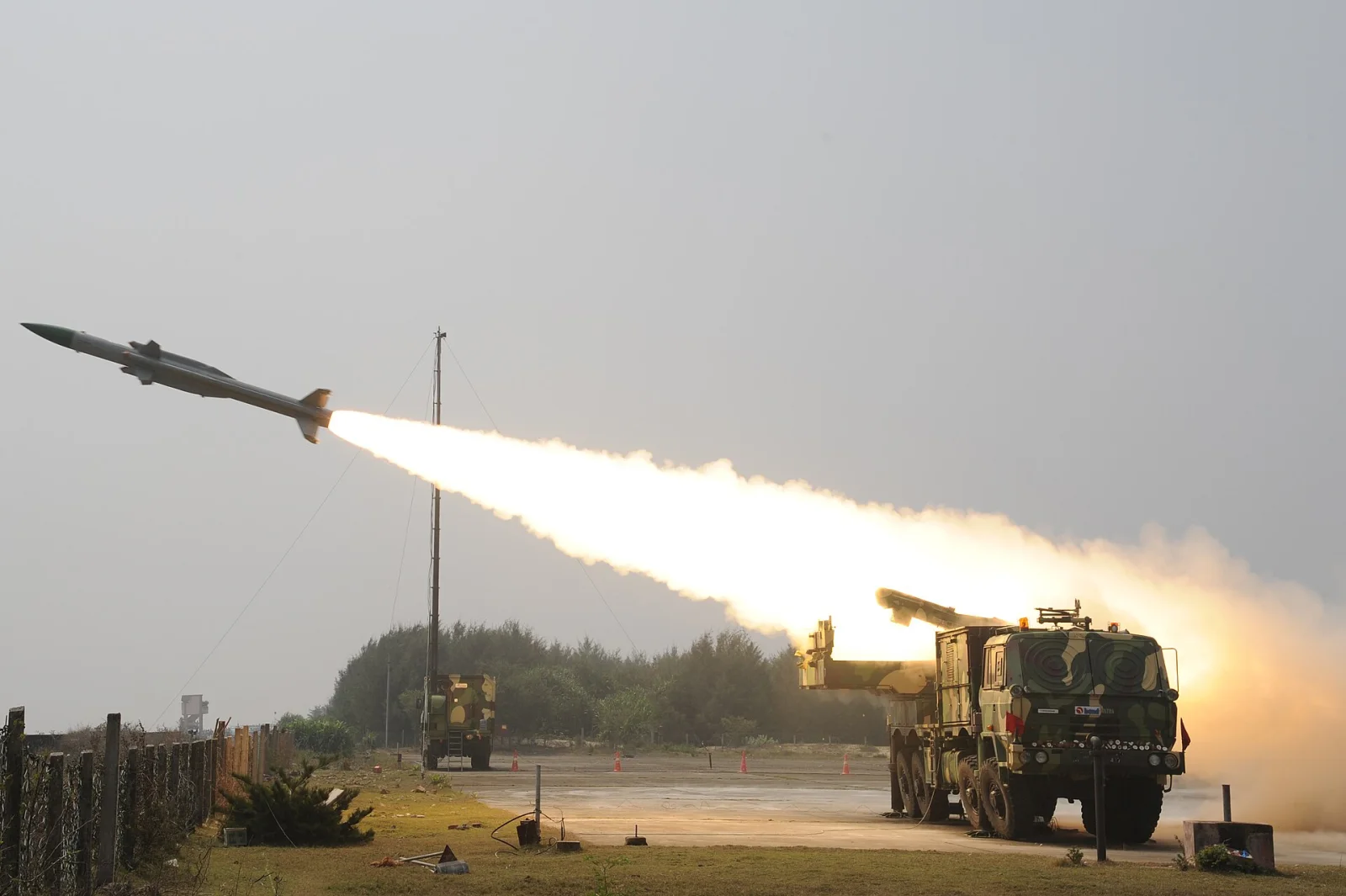
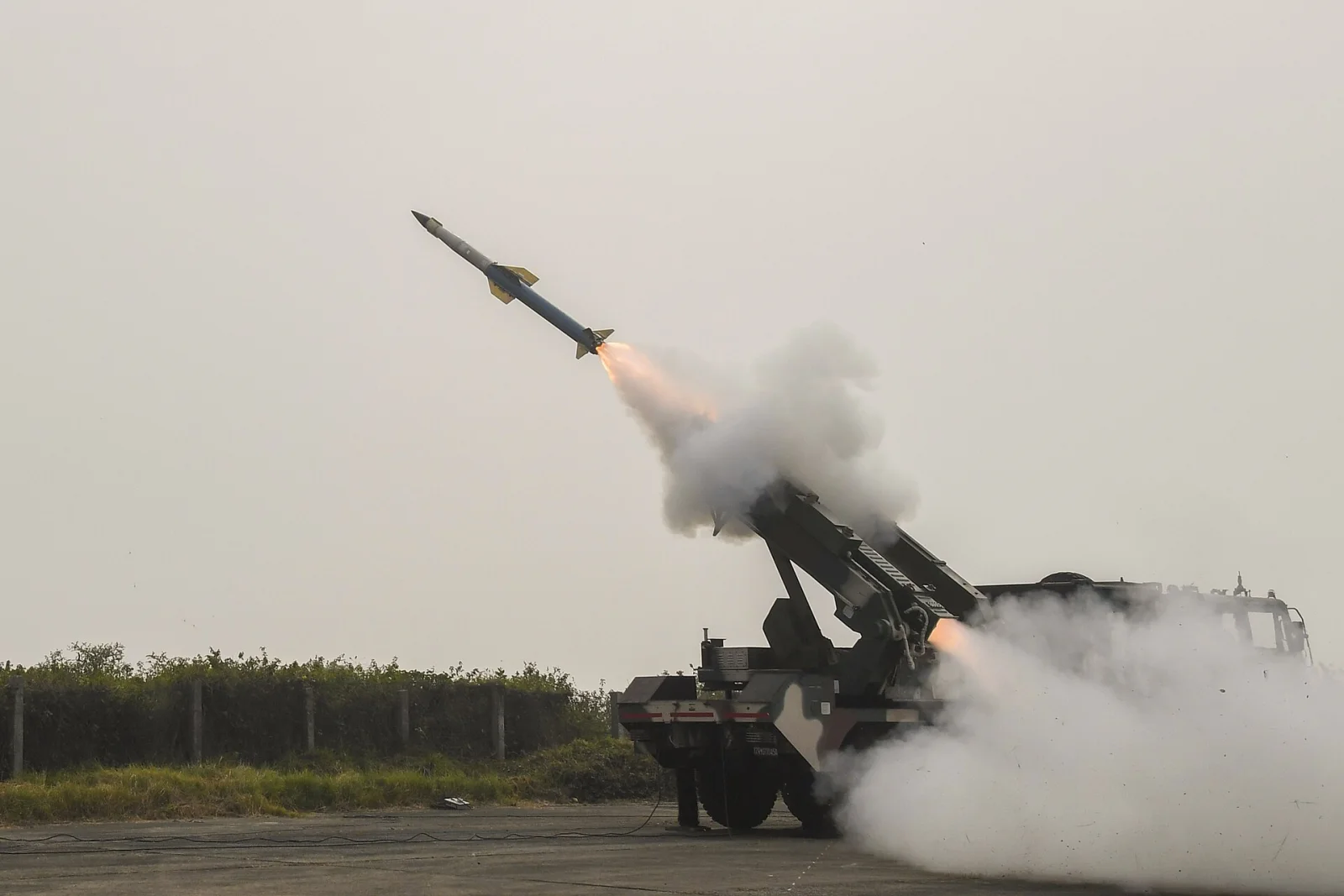
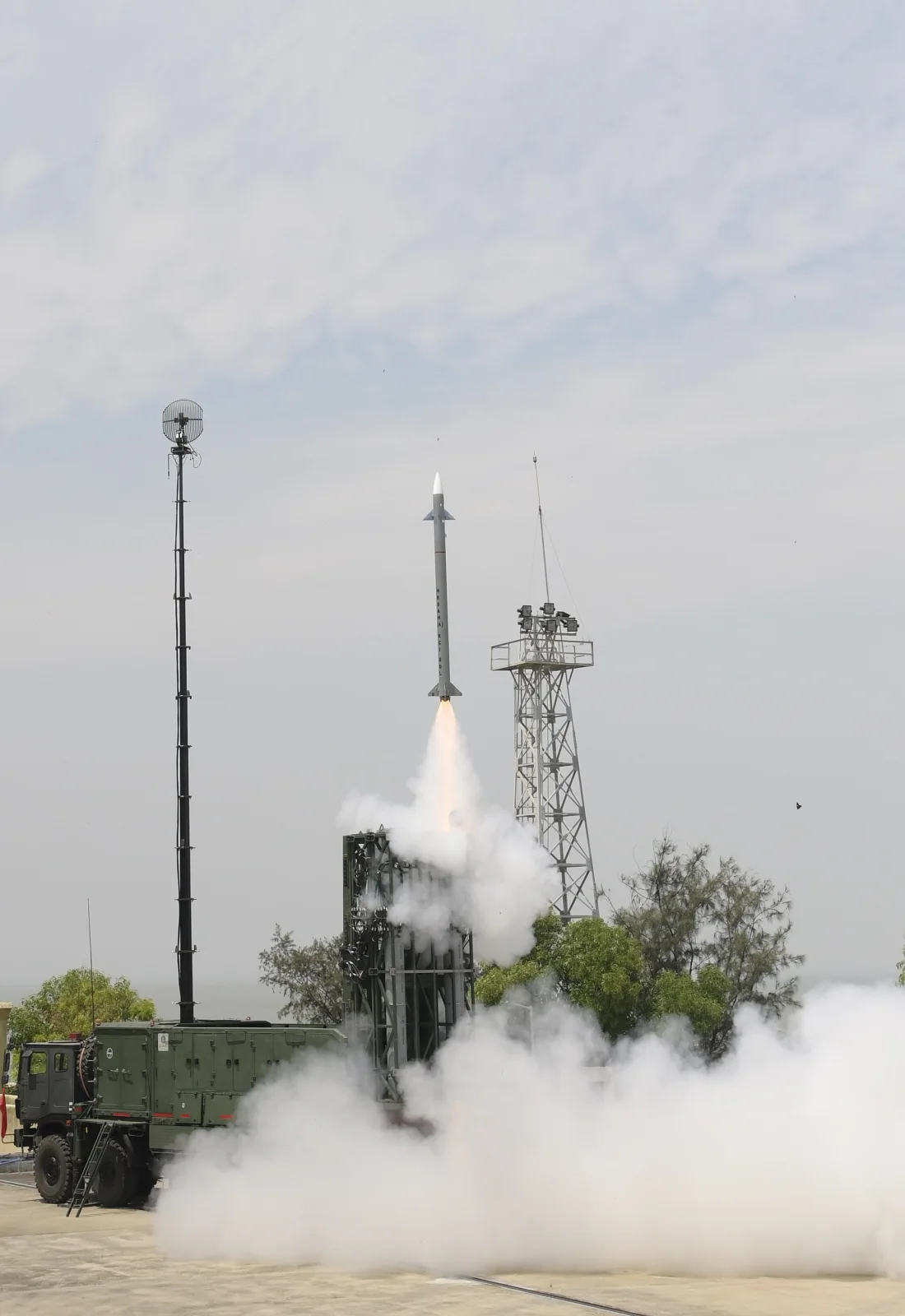
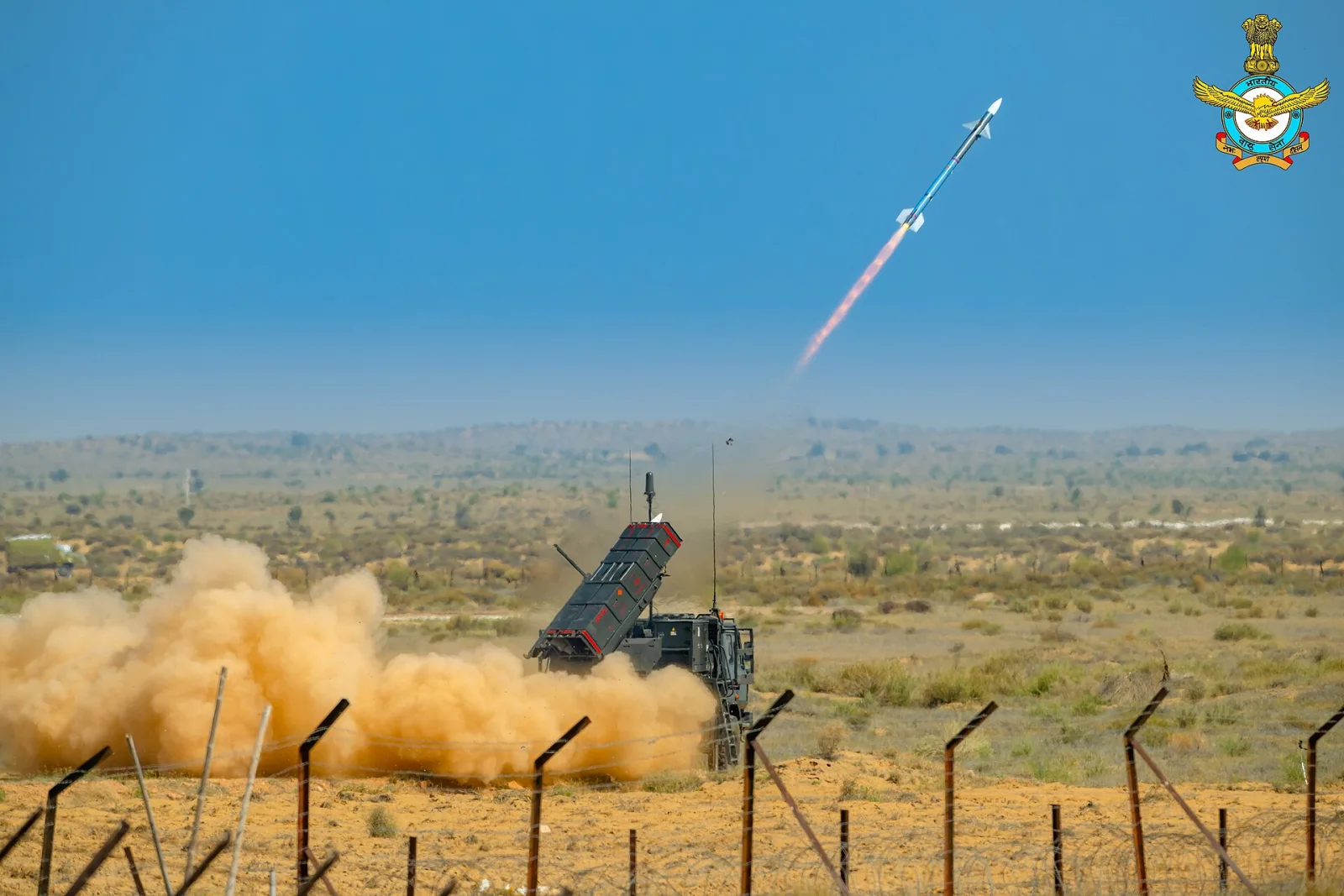
| Launcher | Trainable 360° launcher on tracked (T-72, BMP-2) or wheeled/trailer chassis; improved Army version adds 360° engagement[5][6] | Mobile canister launcher on an 8×8 truck; fires from short halts[4][6] | Vertical launch from canisters: 8-cell naval VLS modules and 8-round mobile land launchers[3] | SR/ER: trainable slant launcher with 360° coverage; MR/LR: vertical launcher; All-in-One: launcher, radar and C2 on one 8×8[2] |
|---|
| Rounds per launcher | Three missiles per launcher; four launchers per battery[5][10] | Six missiles per launcher (reference work)[4] | 8 per launcher; an Indian MRSAM firing unit has 3 launchers[3] | Four missiles per firing unit in any Python/Derby mix; up to eight on the All-in-One[2] |
|---|
| Fire control / radar | Rajendra 3D passive phased-array battery radar; group or autonomous mode; ECCM; linked to the IAF's IACCS[9][10] | Active-array battery surveillance radar (120 km) and multifunction radar (80 km), both 360°, search and track on the move[1][3] | MRSAM: multi-function radar, command post and mobile launchers; Indian Navy ships: EL/M-2248 MF-STAR[2][3][6] | SR: EL/M-2106 ATAR L-band AESA; MR: EL/M-2084 S-band Multi-Mission Radar; battery command unit with six firing units[2][7] |
|---|
| Crew | Not recorded | Not recorded | Not recorded | Four-person deployment team (Singapore)[1] |
|---|
| Characteristics |
|---|
| Maximum range (km) † | Up to 25 km† Range reported in secondary sourcesSecondary reference[4][5] | ≈ 30 km† Range reported in secondary sourcesSecondary reference[4] | Up to 150 km† Maximum engagement range as claimed by the developerManufacturer claim[1] | Up to 15 km† Official range band published by the manufacturerOfficial document[1] |
|---|
| Detection range (km) | Not recorded | Up to 120 kmManufacturer claim[3] | Not recorded | Not recorded |
|---|
| Maximum altitude (km) | Up to 20 kmSecondary reference[4] | Not recorded | Not recorded | Up to 9 kmOfficial document[1] |
|---|
| Speed (m/s) | ≈ 850 m/sSecondary reference[5] | ≈ 1,020 m/sSecondary reference[4] | Not recorded | ≈ 1,360 m/sSecondary reference[2] |
|---|
| Mass (kg) | 720 kgSecondary reference[5] | 270 kgSecondary reference[4] | 275 kgSecondary reference[3] | 105 kgSecondary reference[2] |
|---|
| Length (m) | 5.78 mSecondary reference[5] | 4.4 mSecondary reference[4] | 4.5 mSecondary reference[3] | 3.1 mSecondary reference[2] |
|---|
| Ready rounds / magazine | Three missiles per launcher; four launchers per batterySecondary reference[5] | Not recorded | Not recorded | Four missiles per firing unitSecondary reference[2] |
|---|
| Guidance / cueing | Command guidance; active RF terminal seeker on Mk-1S and PrimeOfficial document[3][2] | Inertial mid-course with two-way data link; active RF terminal seekerOfficial document[1][3] | Two-way data link mid-course; active radar seekerSecondary reference[3] | Python-5 infrared imaging seeker; Derby active RF seeker; command line-of-sightOfficial document[1] |
|---|
| Launch / operating platform | Not recorded | Wheeled high-mobility vehicles; six-missile launcherManufacturer claim[3][4] | Mobile land launchers and shipborne vertical launch cellsOfficial document[2][1] | Wheeled truck launchers with a separate command-and-radar vehicleSecondary reference[2] |
|---|
| Programme |
|---|
| Operators (in service / ordered) | 4: India, Armenia, Tajikistan, Turkmenistan[1][5][10] | Not recorded | | 12: India, Singapore, Vietnam, Philippines, Czech Republic, Azerbaijan, Ethiopia, Kenya, Morocco, United Arab Emirates, Romania, Greece[1][2][3][5][6][10] |
|---|
| Platforms and integration | Rajendra 3D PESA battery radar (in service), Integrated Air Command and Control System (IACCS) (in service), Tracked launchers on T-72 and BMP-2 chassis (in service), Wheeled and trailer launchers (Air Force) (in service), Akash Prime high-altitude configuration (above 4,500 m) (tested)[5][7][9][10] | Battery Surveillance Radar and Battery Multifunction Radar (BEL) (tested), 8×8 truck-mounted canister launcher (tested), Integrated Air Defence Weapon System (with VSHORADS and a laser weapon) (tested)[1][2][3][4][7] | Kolkata- and Visakhapatnam-class destroyers (LR-SAM) (in service), Nilgiri-class frigates and INS Vikrant (in service), Sa'ar 5-class corvettes (in service), MRSAM mobile launchers and radar on Tata 8×8 trucks (in service), EL/M-2248 MF-STAR naval radar (in service), Elta MMR radars (Greek Achilles Shield) (ordered)[2][3][9] | EL/M-2106 ATAR radar (SPYDER-SR) (in service), EL/M-2084 Multi-Mission Radar (SPYDER-MR/LR) (in service), MAN RMMV TG-MIL trucks (in service), Tatra T815-7 trucks (SPYDER-MR) (in service), RMMV HX trucks (in service), Tatra 6×6 (SPYDER ER) and 8×8 (SPYDER LR) launchers (tested), SPYDER All-in-One 8×8 (radar, C2 and launcher on one chassis) (tested)[2][6][7][9] |
|---|
| Public contracts | 1 recorded. Latest: 2023-03-30 · India (Army) · 2 regiments · over Rs 8,160 crore[6] | 1 recorded. Latest: 2025-07-03 · India (Ministry of Defence) · about Rs 1.05 lakh crore for all ten proposals[5] | 4 recorded. Latest: 2026-08-31 · Greece · approximately €3 billion for the whole package[4][6][7][9][10][11] | 1 recorded. Latest: 2026-08-31 · Greece · approximately €3 billion for the whole package[10][11] |
|---|
| Production / deliveries | to 2025: about 15,500 missiles cumulative, 2026-02: combat systems for the 3rd and 4th Army regiments delivered[5][8] | Not recorded | BDL Hyderabad facility: 100 missiles a year planned rate[3] | 2022–2024: 3 SPYDER-MR batteries to the Philippines delivered[6] |
|---|
| Latest development | 2026-02-16: 3rd and 4th regiment systems flagged off[8] | 2025-08-23: First Integrated Air Defence Weapon System test[2] | 2025-05: Reported intercept during India–Pakistan fighting[3] | 2026-07: SPYDER ER/LR trials with I-Derby ER and LR[7][8] |
|---|